
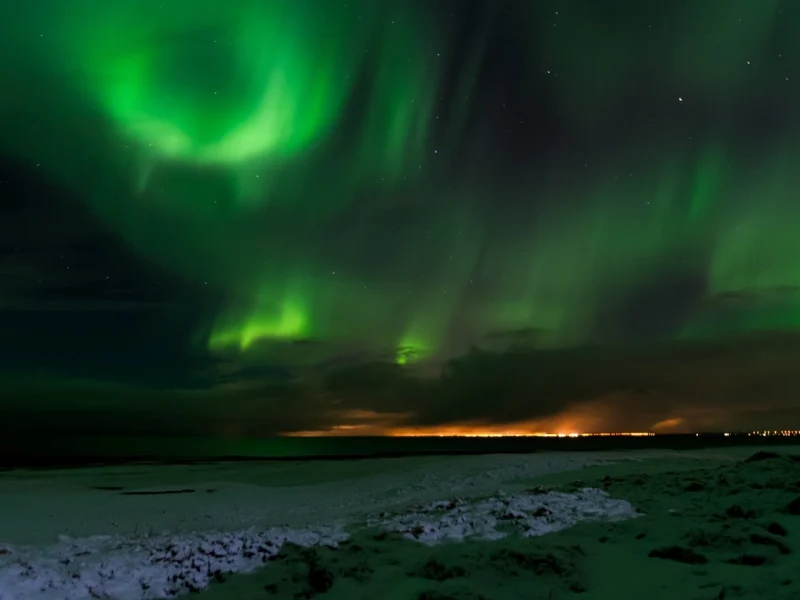
Most people plan a Northern Lights trip around the wrong variable. They pick the month, book one guided night, and hope. The month matters least. What decides whether you see the aurora is how many dark nights you give yourself, how far you get from town lights, and whether the sky is clear — and only the first of those is inside your control.
This guide answers the timing questions in order: the season, the months inside it, the hours inside the night, and how many nights to allow. Vipasha runs our Europe desk and builds these trips around exactly that, which is why our Northern Lights tour packages from India hold more than one aurora night rather than a single scheduled chase.
Norway, Iceland, Finland and Sweden are all inside the Schengen area, so Indian passport holders need a Schengen visa before travelling — our Schengen visa services team handles the application and the appointment slot.
Quick answer: the best time to see the northern lights
| Season | September to March |
| Best months | September and March, around the equinoxes, when solar activity is higher and the weather is milder |
| Peak season for darkness | December and January: the longest nights, but the coldest and cloudiest |
| Best hours | 9 pm to 2 am, strongest near midnight |
| Nights to allow | At least 4–5 nights in the Arctic |
| From India? | Not possible to plan: you need to travel to Norway, Finland, Sweden or Iceland |
When is the best time to see the Northern Lights?
The best time to see the Northern Lights is September to March, because that is when the sky in the Arctic is dark enough for long enough. Some years the season stretches into early April.
The aurora is happening all year. You cannot see it from May to August because the sun barely sets that far north — the midnight sun and the Northern Lights are mutually exclusive, and no amount of planning gets around it.
Within the September-to-March window, three things vary: how long the darkness lasts, how bad the weather is, and how active the sun is. December and January are the darkest and also the cloudiest. September and March give shorter nights but better skies. That trade is the whole planning problem.
Aurora activity also follows a roughly eleven-year solar cycle, and the current cycle peaked recently, which makes the next few winters better than average. That is a reason to go sooner rather than later.
Which months are best for the Northern Lights?
September and March are the two best months, and that is not a compromise answer — geomagnetic activity is measurably higher around the two equinoxes.
The effect is real and well documented: the way the Earth’s magnetic field lines up with the solar wind around the March and September equinoxes makes disturbances more likely. Those two months also happen to have better weather and milder temperatures than midwinter.
| Month | Darkness | Weather | Verdict |
|---|---|---|---|
| September | Shorter nights, season just opening | Mildest, clearest of the season | Best overall — equinox activity, no extreme cold |
| October | Improving | Wet in coastal Norway and Iceland | Good |
| November | Long nights | Cloudiest month in many places | Fair |
| December | Darkest, polar night in the far north | Cold and cloudy | Popular for Christmas, not for odds |
| January | Very long nights | Coldest, often −20°C or below | Fair, and hard work |
| February | Long nights, improving weather | Cold but clearer | Good |
| March | Balanced | Clearer, milder | Best overall — equinox activity, comfortable |
December is the month most people book and it is not the best month. It is booked because of the Christmas holidays, not because the aurora is better then — and prices in Lapland are at their peak.
What time of night are the Northern Lights strongest?
Roughly 9pm to 2am, with the strongest displays usually close to local midnight.
The aurora is tied to Earth’s magnetic midnight rather than clock midnight, but in practice the window is the same: be outside and away from lights from about nine in the evening, and be prepared to stay up. Displays often come in bursts of ten or twenty minutes with long quiet gaps between them, so leaving after half an hour is the most common way to miss one.
This is also why an aurora trip disrupts sleep more than people expect, and why it is worth thinking about with young children or elderly parents in the group. A late-night chase in −20°C is not for everyone, and there is no shame in booking a hotel with a glass roof instead.
How many nights do you need to be sure of seeing the Northern Lights?
Three clear nights is the realistic minimum, and we would plan for four. One night is a coin toss with bad odds.
Nothing about this is a marketing line — it is simply cloud. On any given night in Tromsø or Iceland in winter, the sky may be completely overcast, and no forecast, guide or tour can do anything about it. Over three or four nights, the chance that at least one is clear rises sharply.
This is the single most common mistake we see. Someone books a four-night trip with one “Northern Lights tour” included, the tour night is cloudy, and the trip is a disappointment. Booking a chase on two or three separate nights costs less than most people assume and changes the outcome completely.
Planning a Northern Lights trip? Message our Europe desk on WhatsApp at +91 6300303169 and ask for Vipasha. Tell us your dates, how many are travelling and whether you want Norway, Iceland or Finnish Lapland, and we will build in enough nights to give it a real chance.
Where are the best places to see the Northern Lights?
Tromsø in northern Norway, Finnish and Swedish Lapland, and Iceland are the four we send travellers to, and they suit different trips rather than being ranked against each other.
Tromsø, Norway — around 69°N, well inside the auroral oval, with the best guided chasing anywhere. Guides here drive for hours to find a gap in the cloud, sometimes crossing into Finland to get it. If seeing the aurora is the entire point of the trip, this is the choice.
Finnish Lapland — Rovaniemi and Saariselkä. Lower odds than Tromsø, but the glass igloos and glass-roofed cabins are here, and so is the reindeer, husky and Santa Village side of a Lapland trip. The best choice for families with children.
Swedish Lapland — Abisko has a genuine advantage: it sits in a rain shadow that gives it more clear nights than the coast. Quieter and less developed than the other two.
Iceland — the aurora is a bonus rather than the point. You come for the Golden Circle, the South Coast and Jökulsárlón, and you get aurora nights on top. The best choice if you want a full holiday rather than an aurora hunt — see our Iceland tour packages and Norway tour packages.
Northern Lights tours in Iceland
- Land of Northern Lights, 5 days — two aurora evenings in South Iceland, Sep–Apr.
- Iceland Circle & Northern Lights, 8 days — five aurora evenings around the Ring Road.
- Northern Lights & Westfjords, 11 days — six evenings, including the dark-sky Westfjords.
- Christmas in Iceland, 5 days and New Year in Iceland, 5 days — fixed holiday departures.
See all Northern Lights tour packages from India.
Does the KP index tell you whether you will see them?
The KP index measures geomagnetic activity on a scale of 0 to 9, but at Tromsø or Lapland latitudes a KP of 2 or 3 is already enough — so the cloud forecast is far more useful than the KP number.
KP matters when you are further south, because it tells you how far the auroral oval has expanded. Inside the oval, the aurora is overhead at low KP, and a high KP with total cloud cover shows you nothing.
Check the local meteorological service’s cloud map for the afternoon and evening, then decide where to drive. That is what good guides actually do, and it is why a guide who chases is worth more than one who takes you to a fixed viewpoint.
Can You See the Northern Lights in Ladakh or Anywhere in India?
There is no month when you can plan to see the northern lights in Ladakh or anywhere else in India. India is far too far south of the auroral zone, so the aurora is not a seasonal event here at all.
The one exception on record is worth knowing because it tells you how rare this is: during an exceptionally strong geomagnetic storm in 2024, a faint red aurora was recorded from the Hanle observatory in Ladakh, at over 4,500 metres in one of the darkest skies in the world. That was a scientific observation during an extreme event, not something to build a trip around.
So if you have seen photos of a red glow over Ladakh and searched for the best month to go, the honest answer is that no month is reliable. Those sightings happen only during rare, extreme solar storms that nobody can predict weeks ahead. For a real chance of seeing the aurora, you need to travel north of the Arctic Circle, to Norway, Finland, Sweden or Iceland, between September and March.
If you want to see the aurora, you have to go north. That is the honest answer, and it is why every serious option on this page is a five-to-seven-day trip to the Arctic.
What should you wear to see the Northern Lights?
Thermal base layers, a mid layer of fleece or down, a windproof outer shell, insulated waterproof boots, and a hat and gloves that cover everything — because you will be standing still outside for hours in temperatures that can reach −20°C or lower.
Standing still is the part people underestimate. Walking in the cold is manageable; standing in a field at midnight waiting for a display is not, and clothing that felt fine during the day will not do.
Practical points from our travellers, and none of these are obvious:
- Boots matter more than the coat. Cold comes up through the feet first.
- Take two pairs of gloves — thin liners you can operate a camera in, and thick mittens over them.
- Cover your face. A neck gaiter that pulls up over the nose makes a bigger difference than anything else.
- Most Arctic tour operators lend thermal outer suits. Ask before buying an expensive coat you will wear once.
- Hand and toe warmers are cheap, sold everywhere in the Arctic, and worth carrying.
How do you photograph the Northern Lights?
You need a camera that allows manual settings and a tripod. A recent phone in night mode will capture something, but it will not capture a moving display well.
The starting point most guides give: manual mode, the widest aperture your lens has, a shutter of five to fifteen seconds, and ISO between 1600 and 3200. Focus manually on a distant light or a bright star, because autofocus will hunt in the dark. Then adjust from the first frame.
The thing nobody warns you about: cold destroys batteries. A battery that shows full will die in twenty minutes at −20°C. Carry two or three spares in an inside pocket against your body, and swap them as they fade.
And one honest note. The camera sees more colour than your eye does. A display that looks pale grey-green to you can come out vivid on a long exposure. That is not a trick — it is how long exposures work — but it is worth knowing so the display in front of you is not a disappointment against the photographs you have seen.
When is the best time to visit Norway, Iceland and Finland for the aurora?
All three share the September-to-March window, but the best month inside it differs by country and by what else you want from the trip.
Norway (Tromsø) — September to March, with late September and March the best balance of activity and weather. Winter here is coastal, so milder than Lapland but cloudier.
Iceland — September to March. September and March again, and they have the advantage that the roads and the Golden Circle are still comfortably drivable, which is not true in January.
Finnish Lapland — September to March, with December to February the classic season because that is when the snow, the huskies and the glass igloos are at their best. Colder and drier than the Norwegian coast.
Sweden (Abisko) — the whole season, with the rain-shadow advantage making it more consistent than the others.
If you want one recommendation: late September or early-to-mid March, in Tromsø, over four nights. That is the version of this trip that works most reliably.
Frequently asked questions on Northern Lights Tour
What is the best time to see the Northern Lights?
September to March, when Arctic nights are dark enough. September and March are the two strongest months, because geomagnetic activity is higher around the equinoxes and the weather is better than midwinter.
What is the best time of night to see the aurora borealis?
Between about 9pm and 2am, with the strongest displays usually close to local midnight. Displays come in bursts with quiet gaps, so plan to stay out for several hours.
How many nights do I need to see the Northern Lights?
Three clear nights is the realistic minimum and four is safer. Cloud, not aurora activity, is what stops most people seeing them, so multiple nights matter more than any single tour.
Which month is best for the Northern Lights?
September and March. December is the month most people book because of the Christmas holidays, but it is the darkest, cloudiest and most expensive time to go.
Can you see the Northern Lights in India?
No. India is far too far south. A faint red aurora was recorded from the Hanle observatory in Ladakh during an extreme geomagnetic storm in 2024, but that is not something you can plan a trip around.
Where is the best place to see the Northern Lights?
Tromsø in northern Norway for the best odds and the best guided chasing, Finnish Lapland for families, Abisko in Sweden for clear skies, and Iceland if you want a full holiday with the aurora as a bonus.
Do I need a visa for a Northern Lights trip?
Yes. Norway, Iceland, Finland and Sweden are all in the Schengen area, so Indian passport holders need a Schengen visa.
Does a high KP index mean I will see the aurora?
Not on its own. At Arctic latitudes a KP of 2 or 3 is already enough, so the cloud forecast is more useful than the KP number. A high KP under total cloud shows you nothing.
Is there a peak season for the northern lights?
Yes. The season runs from September to March, and within it, September and March are the peak months for activity because of the equinoxes. December and January have the longest nights, but more cloud and extreme cold.
Can you see the northern lights in Ladakh, and in which month?
Not in any month you can plan for. The aurora has been recorded over Hanle in Ladakh only during rare, extreme solar storms. To see it reliably, travel to the Arctic, to Norway, Finland, Sweden or Iceland, between September and March.
Planning a Northern Lights trip? Send us your travel dates, how many are travelling, and whether you would rather have Tromsø for the best odds, Lapland for the huskies and glass igloos, or Iceland for a full holiday with aurora nights on top. Vipasha on our Europe desk will build in enough nights to give it a real chance. WhatsApp at +91 6300303169 , or see our Northern Lights tour packages from India.
Last verified: 29 August 2026. Aurora activity, weather and tour availability change season to season. Confirm current conditions before you travel.