
Most people arrive in Kerala with a list of four names — Munnar, Alleppey, Kochi, Kovalam — and try to fit all of them into five days. It is the single most common way a Kerala trip goes wrong. The state is long and narrow, the roads through the hills are slow, and the places worth stopping at are spread from Kasaragod in the north to Thiruvananthapuram in the south.
This guide walks through the main attractions in Kerala district by district, so you can pick three or four that actually sit near each other rather than driving past everything. Priyanka, who handles our Domestic India desk, plans these routes every week, and the shape below is the one we keep coming back to.
If you would rather have it planned end to end, our Kerala tour packages cover the hills, the backwaters and the coast in one route, and sit alongside the rest of our India tour packages.
What are the main attractions in Kerala?
Kerala’s main attractions fall into five groups: the tea hills around Munnar and Vagamon, the backwaters at Alleppey and Kumarakom, the colonial harbour quarter at Fort Kochi, the wildlife reserves at Thekkady and Wayanad, and the beaches down the south coast at Kovalam and Varkala.
Almost every Kerala itinerary is some combination of those five. What changes is the order and how many you attempt. A first trip that takes three of them properly will beat one that takes five in passing, and the difference shows up as hours in a car rather than hours anywhere pleasant.
Two things about the state that catch people out. It is one of the few Indian destinations where the monsoon is a season people travel for, not one they avoid — the Ayurveda centres fill up in June and July precisely because the humidity suits the treatment. And the north of the state, from Kozhikode upward, is barely on the standard tourist circuit despite having some of Kerala’s better beaches and its most striking ritual art.
What are the places to visit in Munnar?
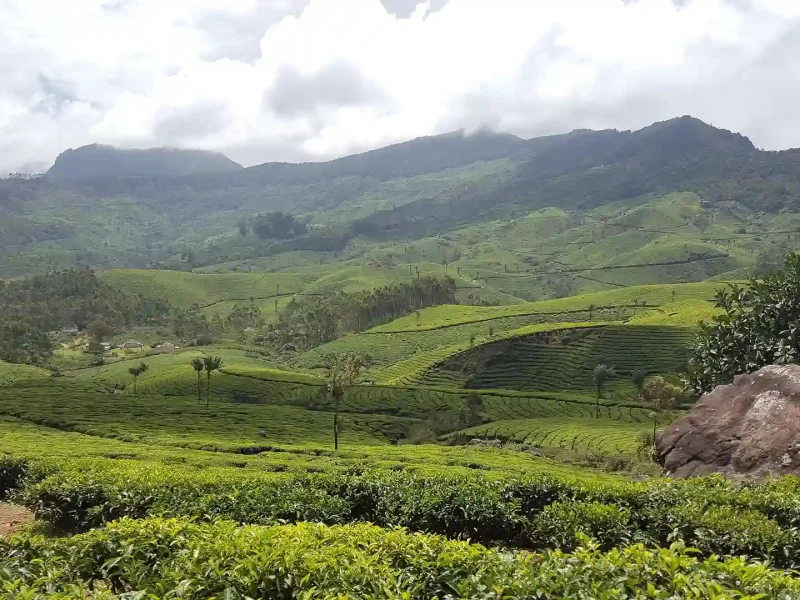
Munnar’s attractions are the tea estates themselves, Eravikulam National Park, Mattupetty Dam and Top Station — a compact set you can cover in a day and a half without rushing.
Eravikulam is the one to plan around. It protects the Nilgiri tahr, a mountain goat you can usually see from the shuttle route rather than needing a trek, and it holds Anamudi, the highest peak in south India. The park normally closes for several weeks in the calving season, broadly February into March. Worth checking before you fix Munnar dates in that window, because arriving to a closed gate is a wasted morning.
Mattupetty Dam and the Kundala area give you the reservoir-and-tea-slope views most people picture when they think of Munnar. Top Station, on the Tamil Nadu border, is the high viewpoint. Go early, because cloud usually comes up the valley by mid-morning. The Tea Museum in town is a genuinely good hour if the weather turns.
Skip the string of roadside “spice gardens” and photo points on the Munnar approach road. They are set up for tour-bus stops and add nothing to a trip that already has real estates in it.
What is there to see in Alleppey and Kumarakom?
Alleppey and Kumarakom are the backwater towns, and the attraction is the water itself — Vembanad Lake, the canal network behind it, and the houseboats and smaller shikara boats that work it.
An overnight houseboat is the standard experience and it is worth doing once. What we tell clients is to be realistic about it: the boats moor for the night rather than cruising, the interesting stretch is the first few hours, and a family with restless children often gets more out of a half-day shikara through the narrow canals than a full night on a big boat. The narrow canals are where you see village life: the ferry jetties, the toddy shops, the school boats.
Kumarakom sits on the Kottayam side of the same lake and is the quieter half, with a bird sanctuary that is worth an early morning between November and February. Marari Beach, a short drive from Alleppey town, is the fishing-village beach that most Kerala itineraries miss entirely.
The Nehru Trophy Boat Race, the big snake-boat event on Punnamada Lake, is usually held in August. If your dates are anywhere near it, tell us early, because accommodation in Alleppey goes long before the date does.
Planning a Kerala route and not sure what to combine? Message our Domestic India desk on WhatsApp at +91 99597 77776 and ask for Priyanka. Tell us your dates, how many of you are travelling and the ages of any children, and we will send back a route that fits the days you actually have.
What are the tourist places in Kochi?
Kochi’s tourist places cluster in Fort Kochi and Mattancherry — the Chinese fishing nets, St Francis Church, the Dutch Palace and the Paradesi Synagogue in Jew Town, and you can walk between all of them in a morning.
St Francis Church is where Vasco da Gama was originally buried before his remains were taken back to Lisbon, which makes it the oldest European church still standing in India. The Dutch Palace at Mattancherry holds the Ramayana murals, The synagogue at the end of Jew Town keeps its hand-painted Chinese floor tiles, no two the same.
The Chinese fishing nets on the Fort Kochi seafront are the photograph everyone takes. Go at either end of the day, not midday.
For an evening, a Kathakali performance with the make-up session beforehand is the thing to book. Watching the artist build the face over an hour explains the form far better than the performance alone does. Kerala Folklore Museum is the other good option and takes about ninety minutes.
Kochi is also the practical hub. Cochin International Airport is where most Kerala trips start and end, and the road from there runs north to Thrissur and Athirappilly Falls or east to Munnar. If you have a spare half-day at the start of a trip, Athirappilly is the one worth using it on.
What are the places to visit in Wayanad?
Wayanad’s places to visit are Edakkal Caves, Chembra Peak, Banasura Sagar Dam and the waterfalls at Soochipara and Meenmutty — a hill district that suits people who want to walk rather than be driven between viewpoints.
Edakkal is the standout and it is genuinely unusual: petroglyphs carved into the rock inside a cleft in the hillside, some of them prehistoric. It is a real climb to reach, in sun, with steps and ladders, which is worth knowing if you are travelling with elderly parents.
Chembra Peak carries the heart-shaped lake that shows up on every Kerala poster. Access to the peak is restricted at times, particularly in fire season, so check status before building a day around it. Banasura Sagar is an earthen dam whose reservoir has left a scatter of small islands, and the boat ride out to them is short and pleasant.
Wayanad Wildlife Sanctuary, with entry at Muthanga and Tholpetty, connects into the larger Nilgiri forest belt — elephant sightings are common enough to be worth the early start.
Wayanad is the part of Kerala we most often recommend for a second visit rather than a first. On a five-day trip it usually costs you the backwaters, and that is a poor trade for a first-timer.
What can you see at Thekkady and Periyar?
Thekkady’s attraction is Periyar Tiger Reserve, and the standard way to see it is the boat cruise on Periyar Lake, with bamboo rafting and guided walks as the better alternatives for anyone willing to start early.
Be honest with yourself about the boat. It is comfortable, it is popular, and on a busy morning it is a large boat full of people. You will see the drowned trees and, with luck, elephants or gaur at the water’s edge. The rafting and trekking programmes run with far fewer people and considerably better odds.
Kumily, the town at the reserve gate, is a spice-growing area — cardamom, pepper, clove, nutmeg. A working plantation walk here is a real one, unlike the roadside versions on the Munnar road, and it is the best hour in Thekkady for children.
Thekkady sits neatly between Munnar and the backwaters, which is why it appears in so many routes. It is a hills-to-water link, not a destination to give three days to.
What are the beaches at Kovalam and Varkala like?
Kovalam is the developed crescent-beach resort south of Thiruvananthapuram, and Varkala is the cliff: a beach with a laterite headland above it, and a temple and a mineral spring at one end.
Kovalam’s Lighthouse Beach, Hawa Beach and Samudra Beach sit in a row, with the lighthouse itself climbable for the view down the coast. It is the easier option for families: shallower entry at the sheltered end, hotels directly behind the sand, and everything within walking distance.
Varkala is the more interesting one. Papanasam Beach below the cliff is a place of pilgrimage as much as a beach. The name means the washing away of sins, and families come to perform last rites at the water. Keep that in mind about how you dress and where you photograph. The cliff path above it runs past cafés and small hotels, and the Janardanaswamy Temple and Sivagiri Mutt sit just inland.
Poovar and the estuary south of Kovalam are the quiet alternative if you want the coast without the crowd.
What are the tourist places in Trivandrum?
Thiruvananthapuram’s tourist places are Padmanabhaswamy Temple, the Napier Museum and Kanakakkunnu Palace in the city, with Ponmudi in the hills and the Kovalam and Poovar beaches to the south.
Padmanabhaswamy has a strict dress code (dhoti for men, saree or long skirt for women, available to hire at the entrance), and admission to the inner shrine is for Hindus only. Worth knowing before you arrive rather than at the gate.
The Napier Museum building is worth the visit on its own, and the zoo and art gallery share the same grounds, which makes it an easy morning with children. Ponmudi, in the hills inland from the city, is the hill station most Kerala itineraries skip because Munnar takes the slot.
Which quieter districts of Kerala are worth visiting?
The northern and eastern districts of Kozhikode, Kannur, Kollam, Palakkad and Idukki carry some of Kerala’s best sights and almost none of the crowds, and they are the right answer for a second or third Kerala trip.
Kozhikode (Calicut). Kappad Beach is where Vasco da Gama landed in 1498. Beypore, just south, is where the traditional uru dhows are still built by hand. It is a working yard, not a museum, and one of the more memorable hours in north Kerala.
Kannur. The reason to come here is Theyyam, the ritual performance held at village shrines through the season that runs roughly December to April. It is not staged for visitors, which is exactly why it is worth seeing. St Angelo Fort and Muzhappilangad, the drive-in beach, are the other two.
Kollam. Ashtamudi Lake is the southern end of the backwater system and much quieter than Alleppey. Jatayu Earth’s Center at Chadayamangalam is the enormous sculpture on the rock, reached by cable car.
Palakkad. Palakkad Fort in the middle of town, Malampuzha’s gardens and dam, and Silent Valley National Park, one of the last stretches of undisturbed tropical evergreen forest in the country, with entry numbers deliberately limited.
Idukki and Vagamon. Vagamon is meadow and pine forest at altitude, and it is the most walkable landscape in Kerala. Idukki Arch Dam sits across a gorge nearby.
Guruvayur Temple in Thrissur district draws very large numbers of pilgrims and admits Hindus only; Athirappilly Falls, in the same district, is open to everyone and is at its most dramatic just after the rains.
How many days do you need to see Kerala?
Five to six days covers three regions comfortably; anything less and you are choosing two. Ten days lets you add the north, which almost nobody does.
The routes that work:
| Days | Route | Suits |
|---|---|---|
| 4–5 | Kochi → Munnar → Alleppey | First-timers, families with young children |
| 5–6 | Kochi → Munnar → Thekkady → Alleppey → Kovalam | The standard full circuit |
| 6–7 | Kochi → Wayanad → Kozhikode → Kannur | Second visit, walkers, north Kerala |
| 7–8 | Trivandrum → Varkala → Kollam → Alleppey → Kochi | Coast and backwaters, south to north |
Two planning notes that save more time than anything else. Fly into one airport and out of another where you can. Kochi in and Trivandrum out turns a there-and-back drive into a straight line. And the hill roads are slower than the distances suggest; a route that looks like three short hops on a map is often a full day in a car.
Our Munnar, Kumarakom and Kovalam in six days route is the standard circuit above, and the five-day Kerala tour is the shorter version for a first trip.
When is the best time to visit Kerala?
The main season runs October to March, when the rain has cleared and the humidity drops; June to September is the monsoon, which is low season for sightseeing and high season for Ayurveda.
October to February is when the hills are clearest and the backwaters are at their best. March onward gets hot and humid on the coast, though the hills stay comfortable later. If you are travelling in the monsoon, Kerala in the monsoon covers what that trip actually looks like. It is a real season here, not a compromise.
The Kerala Department of Tourism publishes current district-level information and festival dates at keralatourism.org.
Frequently asked questions:
What are the famous tourist places in Kerala?
Munnar for the tea hills, Alleppey and Kumarakom for the backwaters, Fort Kochi for the colonial quarter, Thekkady for Periyar Tiger Reserve, Wayanad for forests and waterfalls, and Kovalam and Varkala for the beaches.
Which places should I visit in Kerala first?
On a first trip, Kochi, Munnar and Alleppey. They sit close enough together to see properly in four to five days, and they cover three completely different landscapes.
How many days are enough for a Kerala trip?
Five to six days covers three regions without rushing. Four days means two regions. Ten days lets you add north Kerala, which very few itineraries include.
Which is better for a first visit, Munnar or Wayanad?
Munnar, for a first visit. Wayanad is the better landscape for people who want to walk, but on a short trip it usually costs you the backwaters, and a first-time visitor should not miss those.
Is one night on a houseboat in Alleppey worth it?
Once, yes. The boats moor overnight rather than cruising, so the interesting part is the first few hours. Families with young children often prefer a half-day shikara through the narrow canals instead.
Can non-Hindus enter Padmanabhaswamy Temple and Guruvayur Temple?
No. Both admit Hindus only, and Padmanabhaswamy also enforces a dress code, with dhotis and wraps available to hire at the entrance.
What are the best places to visit in north Kerala?
Kappad and Beypore near Kozhikode, Theyyam performances and Muzhappilangad beach in Kannur, and Silent Valley National Park in Palakkad district.
Is Kerala good to visit during the monsoon?
For Ayurveda and for the landscape, yes. The humidity is what the treatments are timed for and the hills are at their greenest. For beach time and long sightseeing days, no.
Planning a trip to Kerala? Send us your travel dates, how many adults and children are coming and the ages of the children, the hotel category you have in mind and roughly how many days you have. Priyanka on our Domestic India desk will come back with a route built around those days rather than a fixed list. WhatsApp +91 63003 03169, or see our Kerala tour packages.
Last verified: 29 August 2026. Park closures, temple timings and festival dates change. Confirm current status before you travel.