
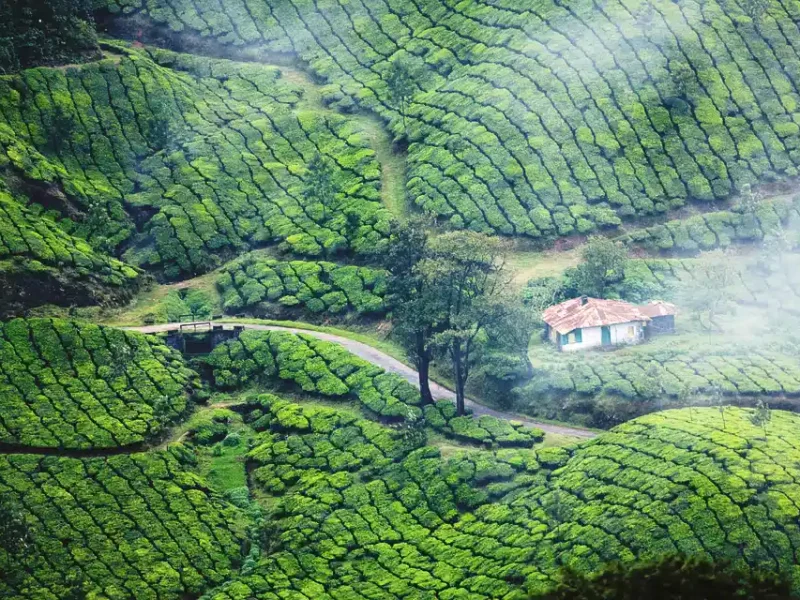
There is a version of Kerala that most of India never sees.
It is not the winter Kerala of packed resorts, fully booked houseboats, and tea-plantation viewpoints crowded with selfie sticks. It is the monsoon Kerala — an entirely different world that opens each June and runs through September, when the Western Ghats turn a shade of green so intense it looks almost painted, waterfalls that were dry channels in April suddenly roar, the backwater channels of Alleppey go glassy and still between rain showers, and the air across Munnar carries the smell of wet earth and eucalyptus that no candle or essential oil has ever managed to replicate.
If you are travelling from Hyderabad and you have been putting off your Kerala trip until “the weather gets better,” we would like to make the case that the monsoon season is not something to wait out. It is something to go for.
Why Hyderabad Travellers Should Choose Kerala This Monsoon
The flight from Hyderabad to Kochi is barely 75 minutes. Hyderabad’s summers are some of the most punishing in South India — June through August regularly crosses 40°C before the rains arrive. Kerala in the same months sits at 22–28°C, humid and lush, with afternoon downpours that cool the air and clear by evening.
That temperature contrast alone is reason enough. But there is more.
Monsoon pricing makes Kerala accessible without compromise. Premium hill resorts in Munnar and heritage bungalows in Thekkady that are fully booked at peak-season rates become available during the monsoon window. Kerala’s best experiences — Ayurveda retreats, private houseboat stays, wildlife safaris in Periyar — are easier to access and book during this period without the rush that characterises November to February.
The landscapes are at their peak. Eravikulam National Park’s rolling grasslands, the tea estates of Munnar, the forest corridors around Wayanad, the backwaters of Kumarakom — all of them look the way Kerala travel photographs are supposed to look, but rarely do in the dry months.
Gulf-based Indian families choose this season deliberately. A significant part of Hyderabad’s community has family connections in the Gulf — UAE, Saudi Arabia, Kuwait, Qatar. For families with relatives visiting from the Gulf during Indian school holidays, Kerala in the monsoon is a natural choice: cool, easy to reach, rich in experiences that feel deeply unlike a Gulf summer.
The Best Places to Visit on a Kerala Monsoon Tour from Hyderabad
A well-planned Kerala itinerary from Hyderabad typically combines 3–4 destinations across 6–8 days. These are the four that define the experience.
Munnar — The Green That Stays With You
Munnar sits at 1,600 metres above sea level in the Idukki district, about four hours from Kochi airport. During the monsoon, the tea estates — 30,000 acres of them — turn every shade from pale sage to deep emerald, and the Nilackal grasslands above the estate level sometimes vanish into cloud. The Eravikulam National Park (home to the endangered Nilgiri Tahr) reopens to visitors in September after its monsoon break, but the estate drives above Munnar are accessible throughout.
What the monsoon gives Munnar that no other season can: the waterfalls. Attukal, Lakkam, Nyayamakad — dramatic in the monsoon months and reduced to trickles from February onwards. The drive from Munnar to Top Station in the rain, winding through tea, mist, and the occasional stream crossing the road, is one of the most quietly spectacular road trips in South India.
Alleppey (Alappuzha) — The Backwaters, the Houseboat, the Stillness
Alleppey is the departure point for Kerala’s backwater network — the classic overnight kettuvallam (rice barge converted into a floating home) drifting through narrow channels lined with coconut palms, Chinese fishing nets, and small fishing communities that have existed in the same way for centuries.
The monsoon transforms the backwaters. The water is higher, the vegetation denser, and the light on a cloudy afternoon on Vembanad Lake has a quality that travellers consistently describe as surreal. The Champakulam Boat Race — one of Kerala’s most celebrated snake boat races — is held in June each year and is worth planning around if your dates allow.
A practical note: Alleppey is coastal and low-lying, so monsoon here means stronger rains than Munnar. The houseboat experience suits travellers who embrace the rain rather than avoid it — the boats are covered and well-equipped, but this is not a trip for those expecting sunshine.
Wayanad — Where the Western Ghats Feel Untouched
Wayanad is Kerala’s northernmost hill district, bordering Karnataka, and is significantly less visited than Munnar or Alleppey. For Hyderabad travellers who have done Kerala once and want something less trafficked, Wayanad is the answer.
During the monsoon, the forests here are alive in a way the dry season cannot replicate. Chembra Peak is closed to trekking in heavy rain, but surrounding forest walks remain accessible. The Nagarhole corridor adjacent to Wayanad is one of the best places in South India to spot wild elephants during the monsoon — animals move toward water sources, and forest thinning creates reliable sighting windows. Coffee and pepper estates around Vythiri and Kalpetta are best in the monsoon, when the estate air is heavy with rain-wet black pepper and the trails are walkable without summer dust.
Thekkady (Periyar) — Wildlife, Spice Gardens, and Colonial Bungalows
Thekkady centres on Periyar Lake, a reservoir surrounded by forests where elephants, bison, sambar, and occasional leopards come to drink. Boat safaris run on a modified monsoon schedule, but the Periyar Tiger Reserve’s “Border Hiking” programme — deep interior guided walks — operates through the monsoon. The spice plantations around Thekkady (cardamom, black pepper, cloves, vanilla) are in active flowering and early fruiting season during July–August, and guided estate tours offer a sensory richness the dry season cannot match.
Kerala Monsoon for Couples — Romantic Experiences
The monsoon transforms Kerala into one of the most genuinely romantic destinations in India — not because of fairy lights and photo opportunities, but because of atmosphere. Mist over the Munnar tea estates at 6 AM, the sound of rain on a houseboat roof on Vembanad Lake, a candlelit dinner inside a century-old plantation bungalow — these are experiences that feel private, unhurried, and quietly exceptional.
The houseboat at dusk on Vembanad Lake. The kettuvallam at sunset on the backwaters — water going copper, fishing boats silhouetted against the sky, the cook on board preparing Kerala fish curry as you drift past villages — is among the most romantic evenings India offers. In the monsoon, the absence of crowds on the lake makes it feel like your own private waterway.
Couples Ayurveda retreat. Monsoon is the officially recommended season for Ayurveda (Karkidaka Chikitsa), and the treatment experience is meaningfully better than other times of year. For couples, a joint session of Abhyanga (warm oil massage) followed by Shirodhara (continuous warm oil poured on the forehead) at a well-regarded retreat property in Kumarakom or Wayanad is genuinely restorative — not a spa day, but a medical tradition done right. A minimum 3 nights at a retreat gives you enough treatment days to feel the difference.
Sunrise over a Munnar tea estate. Most couples who go to Munnar photograph the estate from the road. The better experience: stay at a property set inside the estate, wake at 5:30 AM, and walk 200 metres from your room to watch morning light break over 30,000 acres of tea. This is not a planned activity — it is a detail your accommodation choice determines. IMAD selects properties where this is possible.
A private wildlife boat safari in Periyar. Periyar’s boat safari in the monsoon has a different quality from the crowded winter boats — smaller groups, quieter lake, and elephant families that approach the water in the mornings. Book the Forest Department’s dedicated private safari (available by advance arrangement) for the couple version of this experience.
Candlelit dinner in a heritage plantation bungalow. Several of Kerala’s plantation properties — particularly in Thekkady and Wayanad — were British colonial-era bungalows that have been converted into boutique stays. Dinner in a plantation bungalow dining room during the monsoon, with rain on the tin roof and candlelight on old wood furniture, is a distinctly Kerala experience.
Note: For honeymooners specifically, also see our guide to best honeymoon destinations in India — Kerala features prominently.
Kerala Monsoon with Families — What Works with Children
Kerala in the monsoon is genuinely family-friendly, with the caveat that the best experiences here are sensory and slow rather than activity-heavy. Children who engage with nature, animals, food, and culture will love it. Children who need a beach resort with a water park will not. Matching the trip to your family’s travel style is the most important planning decision.
Periyar boat safari — safe, covered, memorable. The Periyar Lake boat safari is consistently one of the best wildlife experiences for children in South India. The boats are large, stable, and covered — the rain is not a problem. Elephants drinking at the lake edge, otters on the bank, cormorants drying their wings on fallen trees — children at almost any age find this genuinely engaging, not just another “look at animals through glass” experience.
Champakulam Snake Boat Race (June). If your travel dates allow, the Champakulam Vallam Kali is one of Kerala’s oldest snake boat races and takes place in June each year. The spectacle of 100-foot-long snake boats with 100 oarsmen rowing in unison to traditional percussion is the kind of thing children remember for years. This is a genuine local festival, not a tourist performance.
Spice garden walks. The spice plantation tours around Thekkady are exceptional for children who have never seen where vanilla, cardamom, black pepper, and cloves grow. A good guide makes this into a full sensory experience — smell, touch, taste — and the plantation environment is calm and walkable even in light rain. For children aged 6 and above, this is usually a highlight of the trip.
Houseboat on calm backwaters. The backwater channels (not open sea or lake) are calm enough that families with young children can travel safely on a houseboat. The novelty of sleeping on water, watching the cook prepare fresh Kerala food, and waking up to canal birds and morning mist is something most children find genuinely magical. Recommend the shorter 1-night stay for families with children under 8.
Fort Kochi heritage quarter. The Dutch Palace (Mattancherry), the Jewish Synagogue quarter, and the iconic Chinese fishing nets on the waterfront are accessible on foot and suitable for all ages. The Jewish Synagogue has one of the most unusual collection rooms in India — antique clocks and Belgian glass floor tiles — and most children find the fishing nets fascinating to watch in operation.
Age guidance: Wayanad treks are suitable for confident teenagers; in heavy monsoon rain they are not recommended for young children (under 10). Munnar hill drives involve winding mountain roads that can cause motion sickness in young children — ask IMAD to plan stops accordingly. Alleppey houseboat on the open Vembanad Lake is rougher than backwater channels; families with very young children are better on the canal network rather than the open lake.
The Ayurveda Season — Why Monsoon Is the Right Time
Kerala’s Ayurveda tradition identifies the monsoon months (June–August) as Karkidaka Chikitsa — the recommended season for therapeutic treatments. The logic is physiological: humid air keeps skin pores open, allowing medicated oils used in treatments like Abhyanga (full-body warm oil massage), Shirodhara (continuous warm oil poured on the forehead), and Pizhichil (synchronised four-hand oil treatment) to absorb more deeply into the tissues.
This is not marketing language — it is the clinical position of traditional Kerala Ayurveda practitioners, and it is why the most respected Ayurveda centres in Kerala — from the heritage Kottakkal institutions to forest-edge retreats in Wayanad and lake-view wellness centres in Kumarakom — fill their monsoon Panchakarma programmes with serious wellness travellers rather than those looking for a quick massage add-on.
For a Hyderabad traveller considering a proper Ayurveda retreat, the monsoon window is the medically ideal time. Even a 3-night wellness add-on in Kumarakom or a Wayanad retreat gives you enough treatment days to feel a meaningful difference.
A Sample 7-Day Kerala Itinerary from Hyderabad (Monsoon Edition)
This is the itinerary IMAD most commonly builds for first-time Kerala visitors from Hyderabad during the June–September window. It can be adjusted in duration, pace, and accommodation category.
Day 1 — Hyderabad to Kochi, drive to Munnar (4 hrs)
Morning flight from Hyderabad (HYD) to Kochi (COK), roughly 75 minutes. Depart airport by private vehicle. Afternoon arrival in Munnar; evening estate walk; early dinner and rest.
Couples add-on: Request a plantation bungalow property with estate access.
Family add-on: Plan a spice market visit in Munnar town for the evening.
Day 2 — Munnar: Estate walks, waterfalls, Mattupetty
Mattupetty Dam viewpoint and the Indo-Swiss Cattle Project dairy. Afternoon to Attukal Waterfalls — in full monsoon flow, one of the most dramatic sights in Kerala’s hills. Evening at your property.
Day 3 — Munnar to Thekkady (3 hrs)
Morning drive via the Munnar-Thekkady mountain road — cloud-filled valley views. Afternoon spice garden visit near Kumily. Evening: Kadathanadan Kalari cultural show (Kalaripayattu martial arts, Kerala folk dance — good for families with children).
Couples add-on: Evening Abhyanga session at your Thekkady property.
Day 4 — Thekkady: Periyar Jungle Safari
Morning boat safari on Periyar Lake. Afternoon guided forest border trek with a reserve naturalist. Return for Ayurveda treatment (add-on option: 90-minute session).
Families: The boat safari is the highlight here — book the morning slot for best elephant sightings.
Day 5 — Thekkady to Alleppey (4.5 hrs), board houseboat
Afternoon arrival at Alleppey jetty, board kettuvallam houseboat. Kerala sadya (banana-leaf feast) served on board. Overnight on the houseboat.
Families with young children: Request canal route rather than open Vembanad Lake.
Day 6 — Alleppey Backwaters, disembark, drive to Kochi (2 hrs)
Sunrise on the backwaters — the light through coconut palms over still water with fishing boats going out at dawn. Disembark by 10 AM, drive to Kochi. Afternoon: Fort Kochi heritage walk — Dutch Palace, Jewish Synagogue quarter, Chinese fishing nets.
Day 7 — Kochi, departure to Hyderabad
Morning at leisure in Fort Kochi. Afternoon flight back to Hyderabad.
What to Pack for Kerala in Monsoon
Most packing guides for Kerala monsoon get this wrong. Kerala is warm — 24–28°C even in the rains — so the instinct to pack heavy waterproofs and cold-weather layers is a mistake. Here is what actually works.
Clothing: Breathable cotton or merino fabrics (not synthetic — they hold humidity against skin). Light full-sleeve shirts are useful for forest areas (insects) and Ayurveda sessions (post-treatment, you want loose, clean cotton). Two or three changes daily is fine; most properties and hotels dry clothes overnight — ask at check-in and they will handle it.
Rain gear: A compact folding umbrella handles 90% of Kerala monsoon rain. A lightweight waterproof jacket (not a heavy monsoon raincoat — you will overheat) is useful for houseboat evenings and Wayanad forest walks. Heavy ponchos and rubber boots are unnecessary for this style of travel.
Footwear: Quick-dry sandals are ideal for most Kerala travel — they survive rain, dry within an hour, and handle both houseboat decks and town streets. One pair of closed shoes for forest treks. Formal or leather footwear is unnecessary and will suffer in the humidity.
For families: Light ponchos for young children work better than umbrellas — they keep both hands free, which matters when navigating boat gangways and uneven estate paths.
For Ayurveda: If you have booked an Ayurveda retreat or treatment, bring loose cotton kurtas or pants specifically for post-treatment rest. Synthetic or tight clothing is not recommended after oil treatments.
What to leave at home: Heavy luggage (Kerala travel involves a lot of vehicle transfers — a single 7kg cabin bag per person is manageable; 25kg checked bags slow everything down), formal wear, cold-weather layers, and your schedule-anxiety. Kerala’s best experiences move at a pace that rewards slowness.
How to Plan a Kerala Trip from Hyderabad
When to book flights: 4–6 weeks ahead for the best fares on the HYD-COK sector. IndiGo and Air India both operate direct flights; total flying time is 75–80 minutes. Monsoon is not peak season, so last-minute bookings are possible but carry fare risk.
Which airport: Kochi (COK) is the right arrival airport for most Kerala itineraries — it gives you the best road access to Munnar, Thekkady, and Alleppey. If your itinerary starts with Wayanad, fly into Calicut (CCJ) instead — it saves 2 hours of driving.
Getting around: Kerala is not suited to self-drive in the monsoon. Mountain roads between Munnar and Thekkady get slippery in heavy rain; the Wayanad ghats can close temporarily during intense downpours. IMAD arranges dedicated private vehicles with experienced local drivers for the full trip — the same driver throughout, which also means local knowledge on road conditions, stopping points, and tea-estate access.
Best months within the window:
- June: Opening month, dramatic but unpredictable intensity. Champakulam Boat Race is in June.
- July–August: Peak monsoon — deepest green, maximum waterfall flow, fewest crowds, best Ayurveda season.
- September: Rains easing, good mix of green landscapes with more reliable weather. Eravikulam National Park reopens.
How far in advance to plan: Kerala in the monsoon can be organised 2–3 weeks ahead for most travel — properties have availability and there is no competition for bookings. If you want a specific Ayurveda retreat or the Periyar Border Hiking programme, book those 4–6 weeks ahead as they have limited capacity.
How IMAD Travel Plans Your Kerala Monsoon Tour
IMAD Travel does not sell Kerala as a fixed package. Every trip we build from Hyderabad is designed around what you actually want from the experience — and the first thing we do is ask.
Are you travelling as a couple or a family? Do you want nature-heavy or culture-and-food-heavy? Is Ayurveda a priority or a half-day add-on? Do you want 5 nights or 8? Would you prefer a plantation bungalow in Thekkady over a mainstream resort, even if it has fewer amenities? These details — which most operators skip — determine whether a Kerala trip stays with you for years or fades into another holiday.
Here is what IMAD Travel specifically handles, that you cannot easily arrange on your own:
Property selection: We have visited every property we recommend. We do not list hotels based on online reviews or commission rates. Monsoon Kerala requires knowing which properties handle dampness well, which have functioning generator backup for power cuts, and which are genuinely set inside nature rather than just adjacent to it. That knowledge comes from ground visits.
Transfers: We arrange private chauffeur-driven vehicles throughout — not shared taxis, not rental cars. The same driver from airport to airport. In monsoon mountain driving, knowing your driver and his judgment matters.
On-the-ground adjustments: Kerala in the monsoon occasionally throws curveballs — a road closed by a fallen tree, a safari slot cancelled due to high rainfall, a waterfall that’s too dangerous to approach. Our local team handles these adjustments in real time, so you don’t spend your holiday making calls.
One contact point: From the moment you confirm with IMAD to the moment you return to Hyderabad, there is one WhatsApp number (+91 63003 03169) and one team coordinator. Not a call centre. Not a ticketing system.
Custom packages built around your dates — tell us your travel window and whether you’re going as a couple or family, and we’ll send a tailored Kerala itinerary within 24 hours.
Plan Your Kerala Monsoon Tour with IMAD Travel
Tell us your travel dates and whether you’re going as a couple or family — we’ll send a custom Kerala itinerary tailored to your dates within 24 hours.
WhatsApp: +91 63003 03169
Explore IMAD’s Kerala packages →
Written by the IMAD Travel editorial team. IMAD Travel Pvt Ltd is an IATA-accredited travel agency based in Banjara Hills, Hyderabad, certified by the Ministry of Tourism of India. We have been planning Kerala trips for Hyderabad travellers since 2011.
Frequently Asked Questions — Kerala Monsoon from Hyderabad
Is Kerala safe to visit during the monsoon season?
Yes, for the destinations covered in a typical Hyderabad-Kerala itinerary — Munnar, Alleppey, Thekkady, Wayanad — monsoon travel is safe and well-managed. High-altitude Wayanad treks and open-sea activities are restricted in heavy rain, but all the core experiences (houseboat, wildlife, estate walks, Ayurveda) operate through the season. IMAD monitors road conditions and adjusts transfers if any route is temporarily affected.
How many days is enough for a Kerala trip from Hyderabad?
A meaningful Kerala monsoon experience needs at least 5 nights — enough for Munnar (2N), Thekkady (1N), and Alleppey houseboat (1N) with transit days. 7 nights is the sweet spot for most first-time visitors. 8–10 nights if Wayanad or an Ayurveda retreat is included.
Is the houseboat available during the monsoon?
Yes. Houseboats on Kerala’s backwater channels operate through the monsoon — the rain is part of the experience, not a disruption. On days of very heavy rainfall, the operators may avoid the open Vembanad Lake and stay on the protected channels, which is actually the more intimate experience anyway. Open-sea houseboat routes (toward coastal areas) are paused during peak monsoon.
Can I visit Kerala with small children (under 5) in the monsoon?
Yes, with the right itinerary. Alleppey backwater channels (not open lake), Thekkady boat safari, and Fort Kochi are all comfortable with very young children. High-altitude treks and full-day forest programmes are not recommended for children under 5 in the monsoon. IMAD adjusts the itinerary structure based on your children’s ages — just tell us when you book.
What to pack for Kerala in June or July?
Light breathable cotton clothing, a compact umbrella, quick-dry sandals, and a lightweight waterproof jacket. Avoid heavy rainwear and cold-weather layers — Kerala monsoon is warm and humid, not cold. Most properties dry clothes overnight. Detailed packing guidance is in the section above.