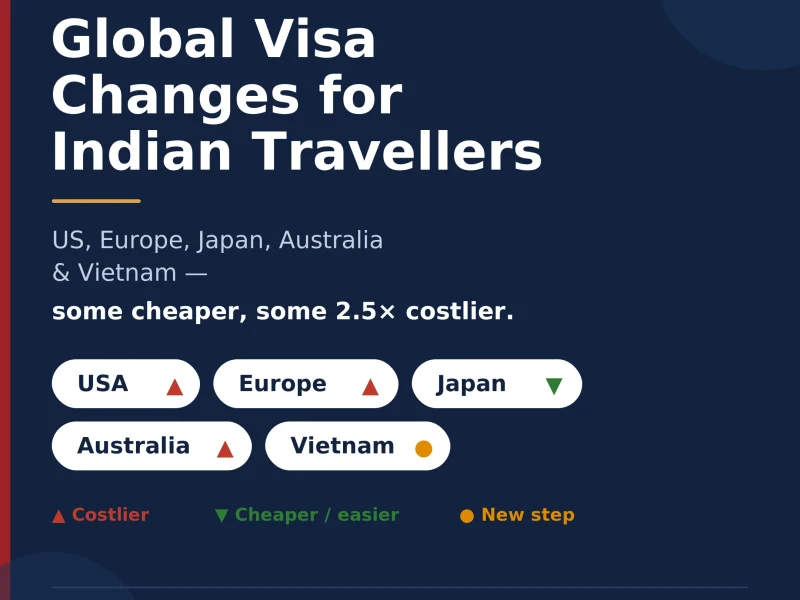
Quick alert: Across 2026, six major destinations changed their visa rules for Indian passport holders — some got cheaper and simpler, others got noticeably more expensive, and one (Thailand) removed visa-free entry for Indians only to restore it weeks later. If a US, Europe, Australia, Japan, Vietnam or Thailand trip is on your 2026–27 plan, a few of these changes directly affect what you’ll pay and how early you need to apply. Here’s the plain-English roundup, with an old-versus-new fee table so you can see exactly what moved.
We’ve handled visas for Indian travellers for over 15 years, so this isn’t a copy-paste of the government notices — it’s what each change actually means when you’re sitting across from us planning a trip. If you’d rather skip the reading and just get your paperwork done right the first time, our visa assistance services cover document review, appointments and timelines for every country below.
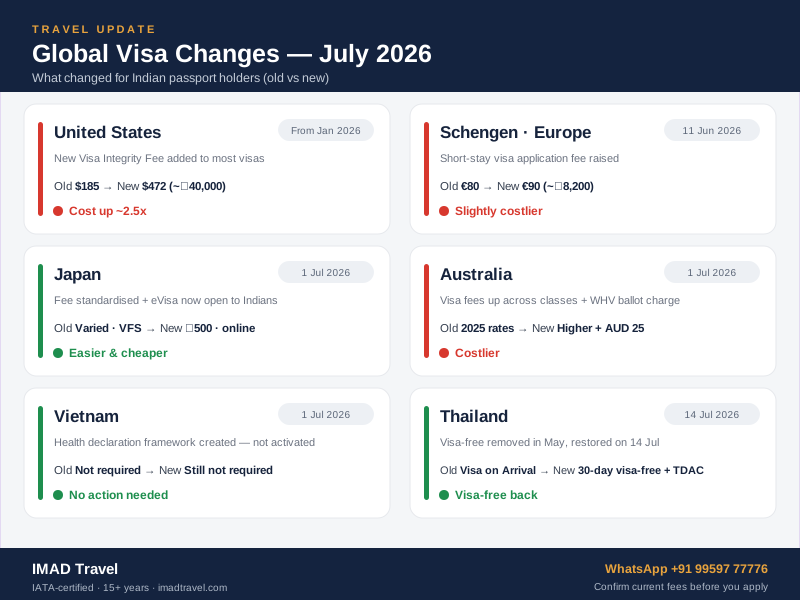
| Country | What changed | Old | New | Effective | Impact for Indians |
|---|---|---|---|---|---|
| United States | Mandatory "Visa Integrity Fee" added to most non-immigrant visas | ~$185 (B1/B2) | ~$472 total (₹39,000–40,000) | From 1 Jan 2026 | 🔴 Cost up ~2.5x + longer interview waits |
| United States | StatesNew fast-track / expedited appointment pilot | Not available | +$750 optional | June 2026 | 🟡 Faster slots, but at a premium |
| Schengen (Europe) | Short-stay visa application fee raised | €80 (~₹7,300) | €90 (~₹8,200) | 11 June 2026 | 🔴 Small cost rise per applicant |
| Japan | Visa fee for Indians standardised + transit merged | Varied by type | ₹500 (single/multiple) | 1 July 2026 | 🟢 Simpler and low-cost |
| Japan | eVisa now open to Indian tourists | Sticker visa via VFS | Online eVisa, up to 90 days | 2026 | 🟢 No VFS visit for tourism |
| Australia | Visa application fees raised across nearly all classes | 2025 rates | Higher 2026 rates | 1 July 2026 | 🔴 Costlier work/skilled/study visas |
| Australia | Work & Holiday (462) ballot charge for India | None | AUD 25 non-refundable | 1 July 2026 | 🔴 Extra non-refundable cost |
| Vietnam | Health declaration framework created, but not activated | Not required | Still not required for normal travel | Framework from 1 July 2026 | 🟢 No action needed for now |
| Thailand | Visa-free entry removed, then restored | 60-day visa-free | 30-day visa-free again (after an interim Visa on Arrival); free TDAC still required | Restored by Cabinet 14 Jul 2026 | 🟢 Visa-free entry back; TDAC mandatory |
Figures are as announced by each government; currency conversions are approximate. Always confirm the exact fee at the time you apply — visa fees can change without notice.
United States: The Biggest Cost Jump for Indian Travellers
The US became significantly more expensive for Indian applicants in 2026. A new $250 “Visa Integrity Fee” now applies to most non-immigrant visas at the point of issuance, added on top of the existing $185 application fee. In practice, a standard B1/B2 tourist or business visa that cost around $185 now runs to roughly $472 — about ₹39,000–₹40,000 per person, a 2.5x jump. For a family of four, consultants estimate close to ₹1 lakh more in combined charges than under the 2025 schedule.
Two things Indian travellers should know. First, the integrity fee cannot be waived or reduced, and it may rise each year with inflation. Second, from June 2026 the US added an optional fast-track pilot — an extra $750 buys an expedited appointment, useful because interview wait times for high-volume posts like Mumbai and Delhi are expected to lengthen while officers adjust to tighter vetting.
Our advice: if a US trip is realistic in the next 12–18 months, start early. The fee is unavoidable, but a long interview queue is not — book the slot well ahead rather than paying for the fast-track later.
Schengen (Europe): A Small Fee Rise, but Timing Still Matters More
The Schengen short-stay visa application fee increased from €80 to €90 (roughly ₹7,300 to ₹8,200) from 11 June 2026. Applications submitted before that date were processed at the old €80 rate. It’s a modest increase in isolation, but for a family it adds up — and it’s not the part that should worry you most.
For Indian travellers, the real Europe bottleneck remains appointment availability, not the fee. Summer and Diwali-season slots fill fast, and a rejected or delayed application can cost you the whole trip. If Europe is on your list, read our full guide to the Schengen visa from India — we handle document review, cover letters and appointment booking so first-time applicants don’t lose weeks to avoidable mistakes. When the visa’s sorted, our Europe tour packages from India cover multi-country itineraries with hand-picked 4–5 star stays.
Planning Europe in 2026–27? WhatsApp our visa desk on +91 63003 03169 and we’ll tell you the current appointment wait for your city before you commit to dates.
Japan: Good News — Cheaper and Almost Entirely Online
Japan got easier for Indian travellers in 2026, not harder. From 1 July 2026, the visa fee for Indian nationals was standardised at a flat ₹500 for single or multiple-entry visas, and the separate transit visa category was merged into the single/double-entry category — one less thing to figure out.
Bigger than the fee: Indian tourists can now use Japan’s eVisa for single-entry short-stay tourism of up to 90 days. That means uploading a digital photo and scanned documents online, paying online, and receiving a “visa issuance notice” in about 5–7 working days — no sticker in your passport and, for eligible applicants, no in-person VFS visit. Japan has quietly become one of the more convenient long-haul visas for Indian holidaymakers, which is worth remembering when you’re comparing East Asia options.
Australia: Costlier, Mainly for Work, Study and Skilled Migration
Australia raised visa application fees across nearly every visa class from 1 July 2026, alongside its usual annual increases. The changes hit work and skilled applicants hardest: the Core Skills Income Threshold rose from AUD 76,515 to AUD 79,499, and the minimum salary for Subclass 482 employer-sponsored nominations was set at around AUD 79,423 per year. Work & Holiday (Subclass 462) applicants from India, China and Vietnam must now also pay a non-refundable AUD 25 ballot registration charge just to be considered — on top of the visa fee.
For pure tourism, the impact is smaller, but the visitor visa fee still went up with the rest. If you’re planning a family holiday to Australia, budget a little more than last year’s figures and apply with buffer time.
Vietnam: The Health Declaration You’ve Probably Read About Isn’t Actually Required
If you are flying to Vietnam, you do not need to complete a health declaration. This one generated a lot of confusing coverage, so it is worth being precise.
Vietnam’s Decree No. 165/2026/NĐ-CP took effect on 1 July 2026 and does create a health declaration mechanism. But Vietnam’s Ministry of Health clarified on 30 June that the decree establishes a legal framework, not a standing requirement. The declaration only applies if the Health Minister activates it in response to a specific disease outbreak, and only for the travellers and border gates named in that announcement.
As things stand, it has not been activated. Indian passport holders flying to Hanoi, Ho Chi Minh City, Da Nang or Phu Quoc need the same documents as before: a valid passport, and a visa or e-visa where required.
Two things worth knowing:
- Ignore tokhaiyte.vn. Vietnam’s Ministry of Health has specifically warned that this site is not used for border health declarations. An official platform is still being built and will only launch if the requirement is activated. If a site asks you to pay for a Vietnam health declaration, it is not legitimate.
- The digital arrival card is separate and does still apply. Vietnam’s Pre-Arrival Information requirement is an immigration matter, unrelated to the health decree, and remains in force at participating entry points.
If Vietnam later activates the declaration, it would be completed online or on paper, in Vietnamese or English, within seven days of your crossing. We track this for every Vietnam booking we handle, and Vipasha on our Asia desk will tell you what actually applies on your travel dates.
Planning Vietnam? See our Vietnam tour packages or read Vietnam vs Thailand for Indian travellers.
Thailand Cuts Visa-Free Stay for Indians from 60 Days to 30
Thailand has reduced its visa exemption from 60 days to 30. The announcement was published in the Royal Gazette on 31 August 2026 (Vol 143, Special Issue 207) and took effect on 15 September 2026. India is one of 60 countries and territories on the 30-day list. Two countries — Seychelles and Mauritius — get 15 days, and Visa on Arrival now applies only to Azerbaijan, Belarus and Serbia, so it is not relevant to Indian travellers. Entry remains visa-free; the free Thailand Digital Arrival Card (TDAC) is still required before arrival.
Where it stands now: Indian passport holders can again enter Thailand visa-free for tourism, for up to 30 days, with no Visa on Arrival needed for a standard trip. The one requirement that never changed is the free Thailand Digital Arrival Card (TDAC), which every traveller must file online within 72 hours before arrival. Carry a confirmed return ticket, hotel booking and the usual cash proof, as these can still be checked at entry. The rule is in force now — Indian passport holders get 30 days visa-free for tourism, with the free TDAC still required.
Thailand remains one of the easiest and best-value destinations we book for Indian families and honeymooners, and it is now simpler to enter than it was in June. For the full breakdown, read our guide to the Thailand visa for Indian passport holders.
And One for Inbound: India’s Own e-Visa Changes
If you have friends, business partners or NRI family visiting India, note that India revised its own e-Visa system in 2026, moving to a reciprocal pricing model where fees mirror what each country charges Indian citizens. The 1-year e-Business visa rose from a flat $80 to a standard $120 (higher for some nationalities), while the 30-day e-Tourist visa is $25 in the July–March window and $10 in April–June. India also expanded e-Visa entry points to 51, which helps cruise and land-border arrivals. It won’t affect your own outbound trips, but it’s useful context if you host visitors.
The Good News vs the Bad News for Indian Citizens
What got better:
- Japan is now cheaper (₹500) and largely online for tourism — a genuine win for Indian holidaymakers.
- Earlier in 2026, several countries eased access for Indian passports — Malaysia stayed visa-free through December 2026, Kazakhstan added visa-free entry, and India climbed the passport-strength rankings.
- India’s expanded e-Visa entry points make it easier to host inbound guests.
- Thailand removed visa-free entry in May but restored it on 14 July 2026 — Indians again get 30-day visa-free entry (the free TDAC is still required).
- Vietnam’s widely reported “mandatory health declaration” turned out not to be mandatory — the framework exists but has not been activated, so nothing changed for travellers.
What got more expensive or stricter:
- The US is the standout negative — roughly 2.5x higher cost per applicant and longer interview waits.
- Schengen fees ticked up €10 per person.
- Australia raised fees across the board and added a ballot charge for Work & Holiday applicants.
The overall picture: leisure travel to Asia is getting cheaper and simpler for Indians, while the US and long-stay/work routes to the West are getting pricier and more paperwork-heavy. Plan the expensive ones early and the easy ones can stay flexible.
How IMAD Travel Helps You Stay Ahead of Visa Changes
Rules like these change with little notice, and a missed detail can cost you a trip. As an IATA-certified agency with 15 years of experience, we track these updates for every country we book and build them into your plan from day one — so you apply at the right fee, in the right window, with documents that don’t get bounced. From a US business visa to a Schengen family holiday or a first Japan trip, our visa assistance services take the guesswork out.
If you’re also renewing your passport this year, read our companion guide on the Indian passport fee hike from July 2026 — passport first, visa second, trip third.
Don’t Forget the Ebola Registration on Arrival
Visa rules aren’t the only paperwork that changed in 2026 — India also updated its arrival requirements. Travellers coming from or transiting through Ebola-affected countries now need to complete an Air Suvidha health registration before landing in India, and immigration is checking for it at major airports. It’s quick and free, but skipping it can mean delays at the counter. If your trip routes through an affected region, read our full guide to the Ebola and Air Suvidha rules for India travel in 2026 before you fly.
Ready to plan around the new rules? WhatsApp us on +91 63003 03169 or request a custom quote, and we’ll map out your passport, visa and package timelines together.
FAQs: Visa Changes for Indians in 2026
Which countries changed visa rules for Indians from July 2026?
The main changes affecting Indian travellers came from the United States (new $250 Visa Integrity Fee from January 2026), Schengen/Europe (fee up to €90 from 11 June), Japan (₹500 standardised fee and eVisa access from 1 July), Australia (higher fees across visa classes from 1 July), Vietnam (a health declaration framework took effect on 1 July but has not been activated, so no action is required) and Thailand (visa-free entry restored on 14 July after a brief removal).
How much does a US visa cost for Indians now?
A standard B1/B2 US visa now costs around $472 in total — roughly ₹39,000–₹40,000 per person — after the $250 Visa Integrity Fee was added to the $185 application fee. The integrity fee cannot be waived and may rise each year.
Did the Schengen visa fee increase in 2026?
Yes. The Schengen short-stay visa application fee rose from €80 to €90 from 11 June 2026. Applications submitted before that date were charged the old €80 rate. See our Schengen visa from India guide for the full process.
Is a Japan visa cheaper for Indians in 2026?
Yes. From 1 July 2026, Japan standardised the visa fee for Indians at ₹500 for single or multiple entry, and Indian tourists can now apply online through Japan’s eVisa for short-stay tourism of up to 90 days, without a VFS visit in eligible cases.
Do I need a health declaration to travel to Vietnam?
No. Vietnam’s Ministry of Health clarified on 30 June 2026 that the health declaration under Decree 165/2026/NĐ-CP is a legal framework, not a routine requirement. It only applies if the Health Minister activates it for a specific disease outbreak, which has not happened. Indian passport holders need a valid passport and a visa or e-visa where required, plus Vietnam’s digital arrival card at participating entry points. Be aware that tokhaiyte.vn is not the official platform — the Ministry has warned against using it, and any site charging a fee for a Vietnam health declaration is not legitimate.
How can I avoid paying more for these visa changes?
Apply early, in the correct fee window, and with correctly prepared documents. Our visa assistance services help you time applications, book scarce appointment slots, and avoid the rejections and re-applications that cost the most.
Is Thailand visa-free for Indians in 2026?
Yes, but for 30 days now — not 60. From 15 September 2026 Indian passport holders get 30 days visa-free in Thailand for tourism, reduced from the earlier 60 days. India is one of 60 countries and territories on the new list, published in Thailand’s Royal Gazette on 31 August 2026 (Vol 143, Special Issue 207). No visa on arrival is needed for a standard tourist trip. Full detail: Thailand visa for Indian passport holders.
Do Indians still need the Thailand Digital Arrival Card (TDAC)?
Yes. The free TDAC is mandatory for every traveller regardless of visa status, and must be filed online within 72 hours before arrival, with the QR code shown at immigration. Only the official immigration.go.th portal is genuine — avoid sites that charge a fee.
Updated 16 September 2026: earlier versions of this guide stated that Thailand removed visa-free entry for Indians in May 2026 and restored it in July. Thailand’s Royal Gazette announcement of 31 August 2026 shows Indian passport holders moved from 60 days to 30 days visa-free with effect from 15 September 2026. The earlier account has been corrected.
Sources: US Visa Integrity Fee — VisaHQ, Manifest Law; Schengen fee — IMAD Travel Visa Team, Khaleej Times; Japan — Ministry of Foreign Affairs of Japan, BusinessToday; Australia — Absolute Immigration, BusinessToday; Vietnam — Ministry of Health notice, 30 June 2026, via Vietnam Government News Portal (baochinhphu.vn); India e-Visa — Business Today. Verify current fees on official government sources before applying.