
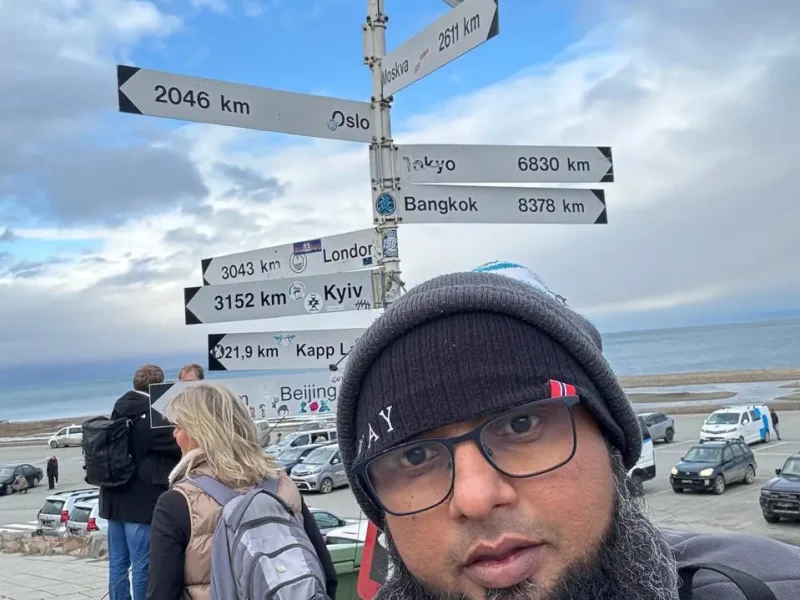
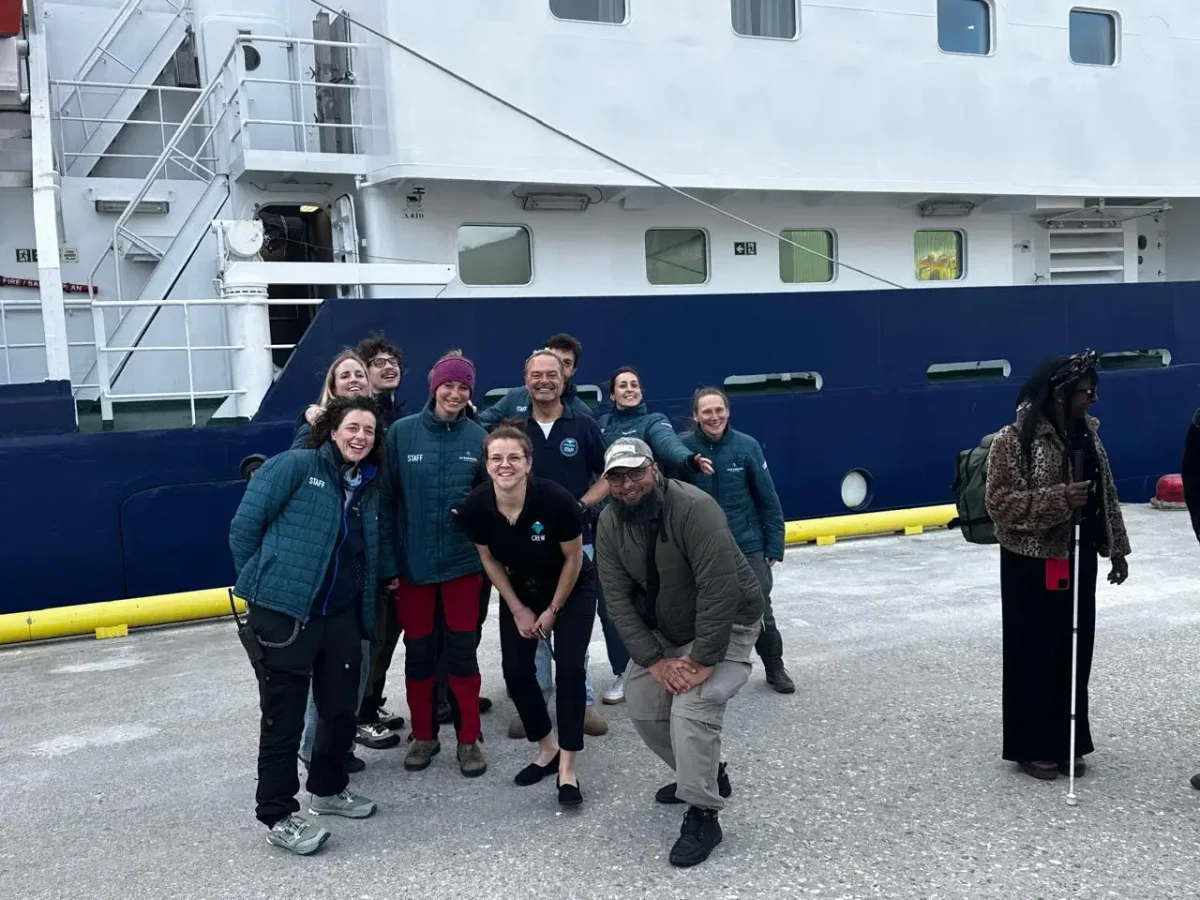
Day 1 — Longyearbyen to M/V Plancius: My Home Starts Moving
On 7 September 2026, we boarded M/V Plancius in Longyearbyen.
For the next five nights, this sturdy Svalbard expedition ship would be our home, classroom, dining room and viewing platform. The voyage eventually covered 672 nautical miles before we disembarked in Tromsø.
There is a small but memorable transition in expedition travel: one minute you are standing in a settlement with roads and buildings; the next, your suitcase is in a cabin, your expedition boots are waiting downstairs, and the ship is quietly carrying you out into Isfjorden. We went through the safety briefing and abandon-ship drill, collected our rubber boots and met the expedition team. Then came dinner — and the first conversations with fellow travellers.
This became one of my favourite parts of the voyage. People arrive as strangers, but after a few Zodiac rides, wildlife sightings and meals together, you begin exchanging stories as though you have known each other much longer.
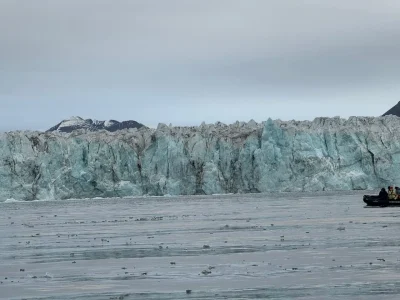
Day 2 — Borebukta and Borebreen: Ice, a Polar Bear and the First Real Arctic Morning
Our first activity day began in Borebukta.
Before every landing or Zodiac cruise, the expedition team briefed us carefully. That combination of freedom and discipline matters in Svalbard, where weather can change quickly and polar bear safety is taken very seriously.
We then headed towards Borebreen. This was where the expedition changed gear. The ship was no longer the destination; it was our base camp. The first time we moved away from the ship in a Zodiac, the scale of the Arctic became real. From the deck, a glacier is beautiful. From a small inflatable boat, with cold air on your face and pieces of ice around you, it becomes something else entirely — alive, textured and enormous.
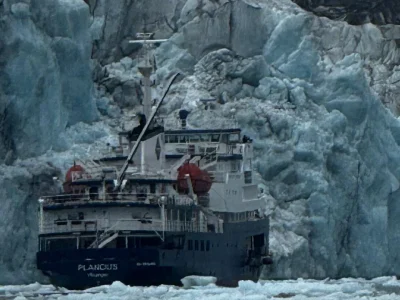
Borebreen is a tidewater glacier. During our voyage it was approximately 3.5 kilometres wide and about 20 kilometres long, and the expedition log recorded that it had advanced almost two kilometres since August 2024. It is also a “surging” glacier — one capable of periods of dramatically faster movement after quieter phases. Standing in a Zodiac, those scientific words suddenly had scale. The ice front was not a static wall; it was a moving system.
There is something reassuring about seeing your expedition ship against a wall of ice. Plancius did not feel like a floating resort pretending the wilderness was outside. The ship felt like part of the expedition itself: practical, comfortable and designed to get us close to places that are difficult to reach any other way.
Svalbard Wildlife: Nothing Feels Staged Here
We cruised through sea ice and along glacier fronts, listening to guides explain how the ice moves and changes. When a glacier calves, you do not only see it; you hear it. The sound rolls across the water, and for a moment everyone stops talking.
One of the details I loved about expedition travel was that the learning never felt like a classroom lecture imposed on a holiday. You would see something outside, then later hear a naturalist explain the geology, wildlife or history behind what you had just experienced. The place itself created the questions.
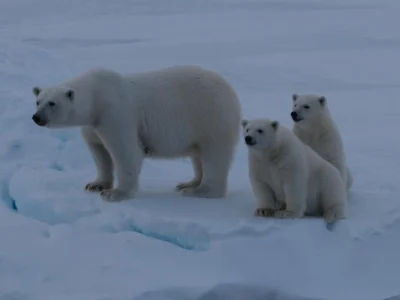
Wildlife was one of the biggest reasons I wanted to experience Svalbard, but the reality is more powerful than a checklist. A polar bear sighting is not a zoo moment, and it is never guaranteed. You scan huge stretches of ice and moraine, and then suddenly a white shape moves where your eyes had previously seen only landscape. We watched from a safe distance as the bear moved along the glacier moraine and through the water. Polar bears are the largest bear species and are closely tied to sea ice, because their most important prey are ice-associated seals — especially ringed and bearded seals.
Around Borebreen we also encountered a ringed seal (Pusa hispida). These small Arctic seals can maintain breathing holes in thick sea ice — one of the adaptations that makes them such a classic High Arctic species, and the same relationship with the ice that makes them important prey for polar bears.
Later, officers spotted white-beaked dolphins, while northern fulmars, black-legged kittiwakes and Arctic skuas gathered over feeding activity. That is what Svalbard does so well: a glacier excursion can suddenly become a wildlife lesson without warning.
In Svalbard, every polar bear encounter is controlled by the animal and by safety — not by a sightseeing schedule.
Alkhornet — Where the Svalbard Tundra Suddenly Became Alive
After lunch, we anchored near Alkhornet, the distinctive mountain at the northern entrance to Isfjorden. After hours of grey-blue ice and water, walking onto greener tundra felt like entering another Arctic world.
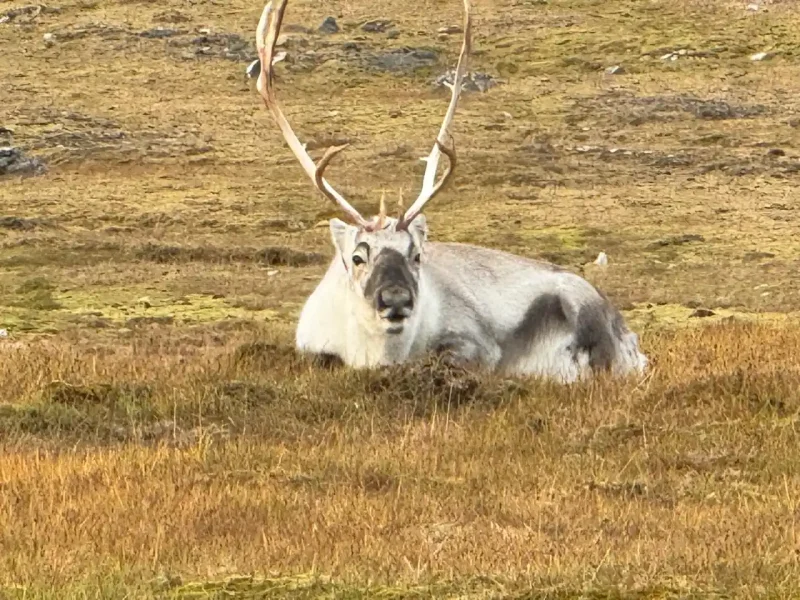
This is where we saw Svalbard reindeer. The Svalbard reindeer (Rangifer tarandus platyrhynchus) is an endemic subspecies — found only in this archipelago. It is shorter-legged and more compact than many mainland reindeer, an Arctic build that helps conserve heat. The males we saw carried developed antlers, while other animals grazed quietly across the tundra.
We also saw Arctic foxes. The Arctic fox (Vulpes lagopus) has a short muzzle, rounded ears and an extraordinarily insulating coat. In Svalbard it lives without the red-fox competition found in some mainland areas, feeding opportunistically on seabirds, eggs, carrion and remains left by polar bears. Seeing one moving through the tundra makes you realise how much wildlife can be present in a landscape that initially looks empty.
Day 3 — Hornsund: Gåshamna, Russian Science and Whaling History
By the next day, we had moved south into Hornsund, one of southern Spitsbergen’s great fjord systems. This was the day the expedition became about more than wildlife and glaciers.
At Gåshamna, history was lying in the landscape — not behind museum glass. Gåshamna means “Goose Bay”. Its sheltered position made it useful to people long before modern expedition ships arrived. The shoreline contains traces of seventeenth-century whaling, later Russian/Pomor and Norwegian trapping activity, and one of the most fascinating scientific chapters in Svalbard: the Swedish-Russian Arc of Meridian Expedition.
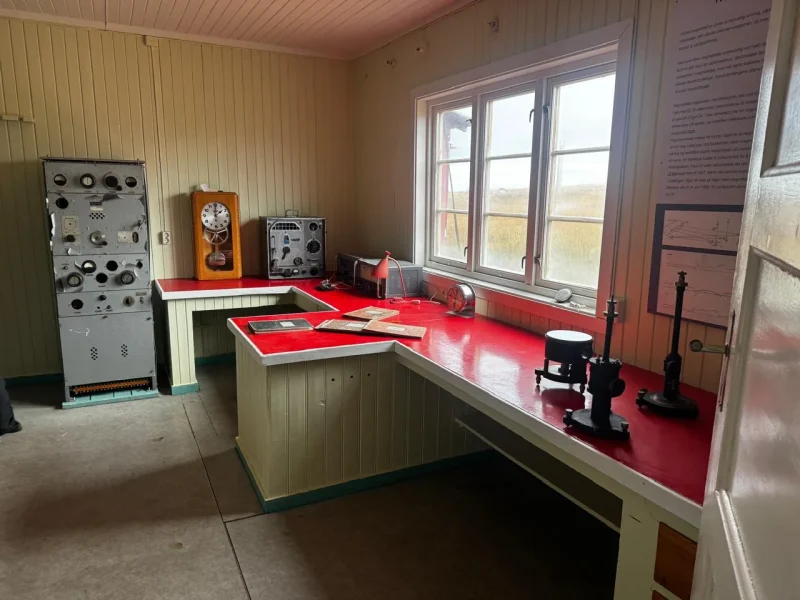
In 1899–1900, the Russian party built a substantial research station here as part of an international attempt to measure a meridian arc and refine knowledge of the Earth’s shape — specifically, the degree to which our planet is flattened at the poles. The station included living quarters, laboratory and observatory facilities. After the expedition the complex deteriorated; materials were reused, and a later trapping station known as Konstantinovka occupied part of the site.
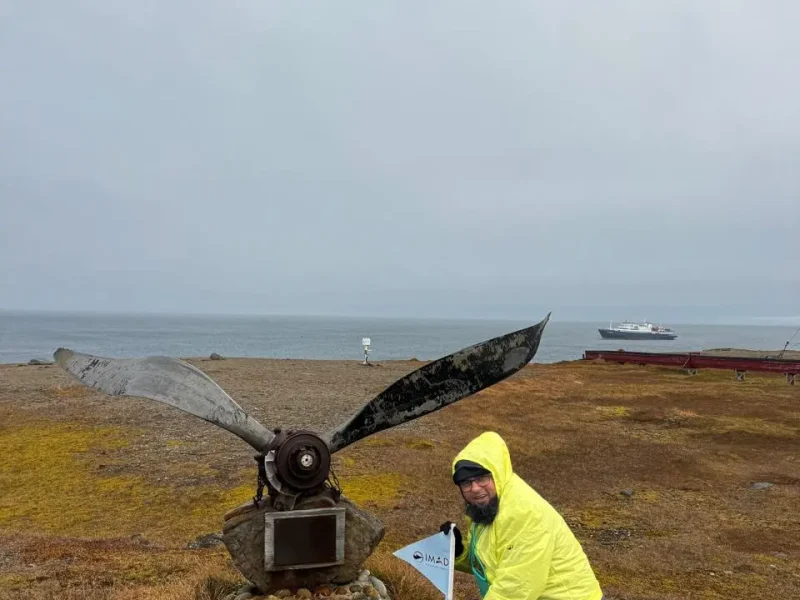
What moved me here was the contrast. Today we arrive with insulated clothing, radios, satellite navigation and a ship waiting offshore. More than a century ago, scientists and trappers overwintered in this environment with equipment that now looks astonishingly simple. The objects and buildings are not decoration — they are evidence of how much effort people invested in understanding and surviving the Arctic.
Gåshamna also carries an older, darker story. Whalers worked these waters from the early seventeenth century, and whale bones and remains of blubber-processing sites survive around the bay. They are protected cultural remains. Walking here, you are not just crossing tundra; you are moving through layers of exploitation, science and survival.
Burgerbukta — Blue Ice, Arctic Silence and a Polar Plunge
From Gåshamna, we continued deeper into Hornsund towards Burgerbukta. The mood changed again. Steep mountains closed around the bay and glacier ice filled the water. From the Zodiac, the colours moved from slate grey to turquoise and deep glacial blue.
At one point, we simply stopped. No conversation. No need to fill the space. For five minutes, we experienced what I can only call Arctic silence. At first, you wait for a sound. Then you begin to notice the tiny ones: water against ice, a distant bird, perhaps the wind. The silence is not empty; it makes you aware of how noisy normal life is. In the Arctic, five minutes can feel surprisingly long.
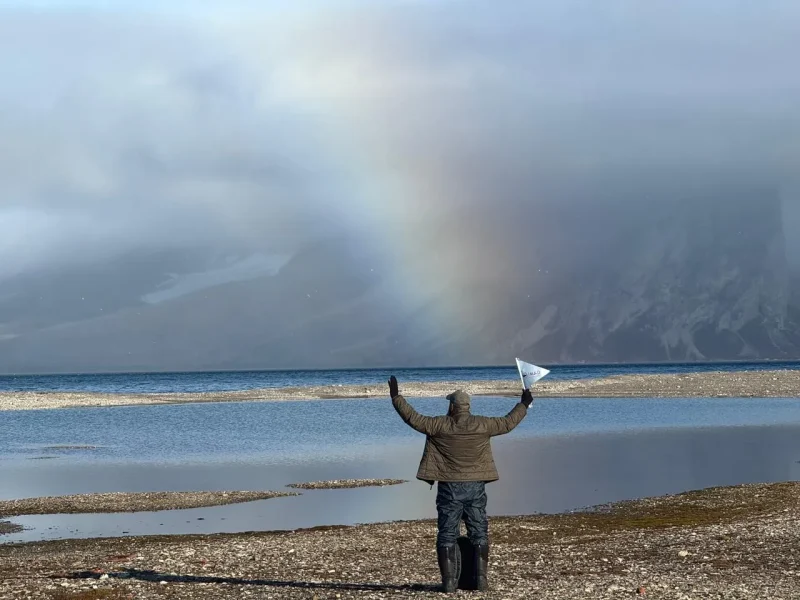
It was one of the moments that reminded me why people travel so far for places like Svalbard: not only to see more, but sometimes to hear less.
And then, because expedition travel has a sense of humour, came the Polar Plunge.
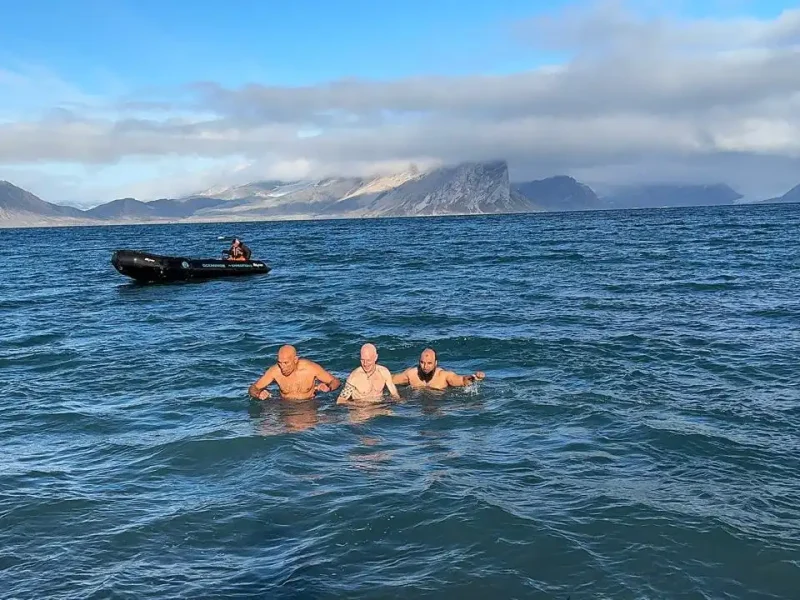
Yes, I did the Polar Plunge. There is no elegant way to describe the first contact with Arctic water — and somehow, you do it anyway. Your body understands the temperature before your brain has finished processing the decision. It was cold, it was fast, and it was absolutely worth doing once. What I remember almost as strongly was the contrast afterwards: warm clothes, hot food and the feeling that we had shared something slightly ridiculous and completely unforgettable.
Day 4 — Bjørnøya (Bear Island): The Remote Island That Connected Everything
We sailed south overnight and woke near Bjørnøya — Bear Island, the southernmost island of the Svalbard archipelago. Geographically, it sits between Spitsbergen and mainland northern Norway, close to the meeting zone of the Norwegian and Barents seas. For me, it also felt like the bridge between the Svalbard part of the expedition and our onward journey to Tromsø.
Bjørnøya was recorded by Willem Barentsz and Jacob van Heemskerck in 1596 and named after a polar bear encountered near the island. Our landing was at the northern weather station, Radio Bjørnøya. The station is still an active outpost, but around it are reminders of earlier attempts at coal mining, fishing and whaling — ventures that struggled against the island’s isolation and conditions. The small museum and historic equipment gave context to the island’s role as a remote observation and communications point.
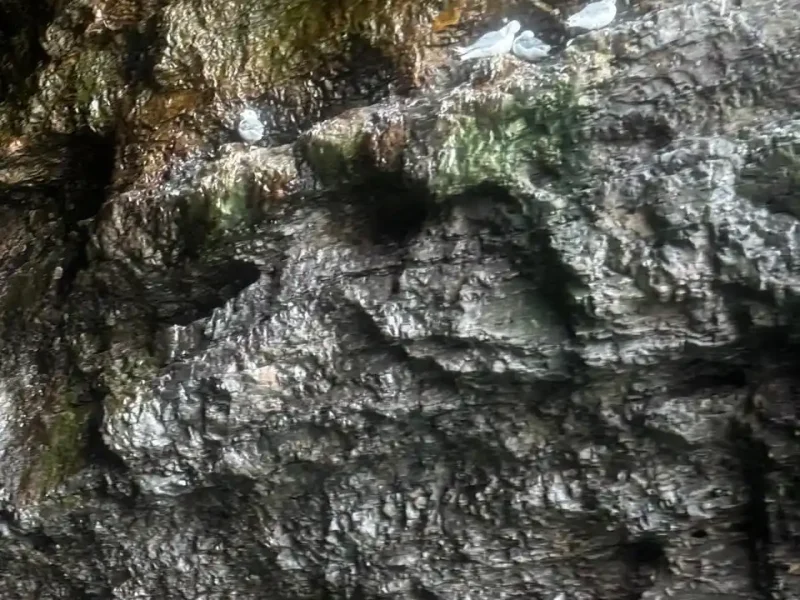
But outside, Bjørnøya’s greatest spectacle was natural: its cliffs. Some of Bear Island’s bird cliffs rise more than 400 metres, and they support huge seasonal colonies. Black-legged kittiwakes (Rissa tridactyla) nest on narrow cliff ledges and are named for their characteristic “kitti-wake” call. Brünnich’s guillemots, or thick-billed murres (Uria lomvia), pack tightly onto rock shelves, while common guillemots (Uria aalge) are also especially important on Bjørnøya. Puffins and northern gannets occur here too.
The cliff cruise was pure expedition: drizzle, swell, wind, caves, arches and tunnels cut into the coastline. Our guides assessed each section before taking the Zodiacs through. One tunnel was reported in the expedition log as being more than a hundred metres long. It is difficult to explain how adventurous that feels until you are sitting low in a rubber boat, entering a dark opening in an Arctic cliff while seabirds circle outside.
We also saw the wreck of a ship that stranded on Bjørnøya in 2009. It was another reminder that even with modern navigation, this coast deserves respect.
The Arctic Birds I Kept Photographing
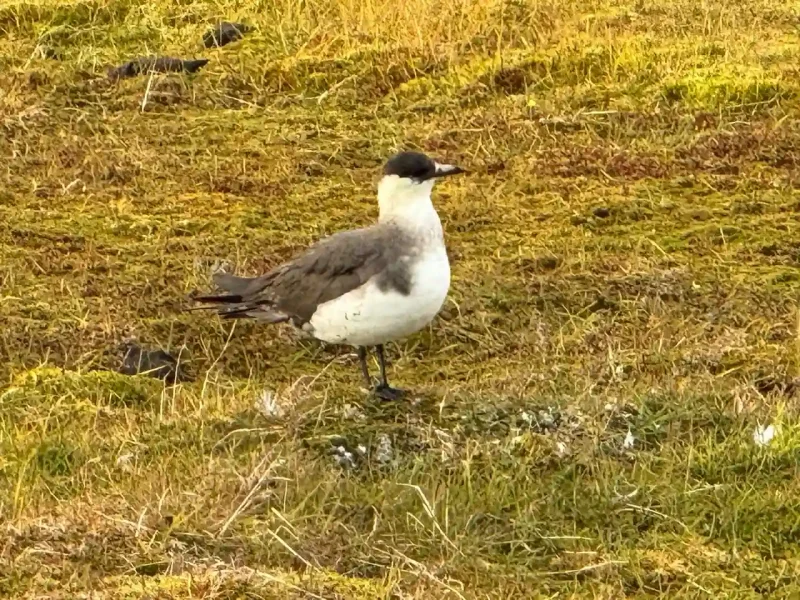
Away from the great colonies, individual birds kept catching my attention. One of the most distinctive was the Arctic skua, also called the parasitic jaeger (Stercorarius parasiticus). It has a predatory, streamlined shape and is famous for kleptoparasitism — chasing other seabirds until they drop or regurgitate food.
I also photographed a mottled young gull. Its pale brown-grey plumage is consistent with a juvenile glaucous gull (Larus hyperboreus), one of the High Arctic’s largest gulls — although I prefer to keep the identification qualified from a photograph alone. Juvenile glaucous gulls are mottled grey and buff and gradually acquire the very pale adult plumage over several years.
Day 5 — South Towards Tromsø: The Orcas We Could Not Stop Watching
By 11 September, we were at sea heading south towards Tromsø. It could easily have become a quiet transit day: breakfast, returning expedition boots, lectures, packing and that slightly sad feeling that the voyage was nearly over.
Instead, the Arctic gave us one of the strongest endings imaginable. From the bridge came the call: orcas.
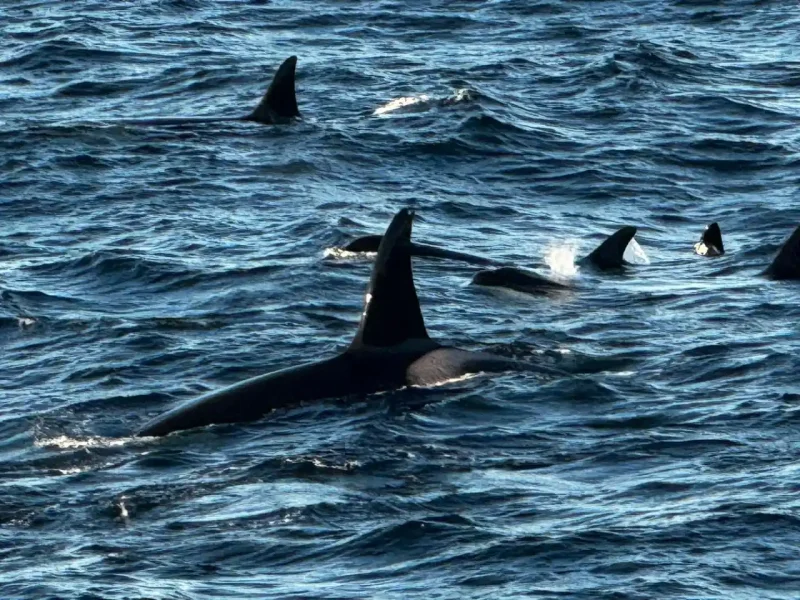
Soon, we were looking at not one animal but large groups moving through the water. The expedition log recorded two groups of at least ten orcas, and a blue whale was also sighted among the activity. Orcas (Orcinus orca) are the largest members of the dolphin family. Their black-and-white pattern looks unmistakable in photographs, but what stays with you is the movement — dorsal fins rising, disappearing and appearing somewhere else.
At times, they were roughly a kilometre away. On paper, one kilometre sounds distant. Out there, surrounded by open water, it did not feel distant at all. Every time someone pointed, everyone searched the surface. A photograph can show you an orca. It cannot give you the cold air on your face, the pause between sightings or the sudden rush when another dorsal fin breaks the water.
The blue whale (Balaenoptera musculus) sighting made the moment even more extraordinary. The blue whale is the largest animal known to have lived on Earth. We did not need it to come close for the scale of that fact to land. Sometimes distance is part of the experience — wildlife remains wild, and you remain a visitor.
What Life Aboard a Svalbard Expedition Ship Actually Adds
It would be easy to write only about the animals and glaciers, but that would leave out half the expedition. Plancius was where the days connected.
The hotel team aboard looked after us extremely well. Meals were something to look forward to, especially after hours outside. But what I valued just as much were the conversations. Expedition travel attracts curious people. By the end of a few days, you have shared cold Zodiac rides, wildlife sightings, meals, lectures and a lot of laughter with people who were strangers when you boarded.
The bridge was also accessible at appropriate times, which gave us a fascinating view of navigation and ship operations. Lectures on wildlife, geology and Arctic history added context to what we were seeing outside. It never felt like information for information’s sake; it made the landscape richer.
The expedition team helped us understand not simply “there is a bird” or “there is a glacier”, but why that species is here, how the ice behaves and what human history lies beneath a seemingly empty shore.
And then there were the people. Expedition travel creates camaraderie quickly because everyone is sharing the same uncertainty. You cannot order a polar bear sighting or schedule an orca. So when something happens, everybody experiences the same burst of excitement together.
If you have sailed with us before on a warm-water itinerary, this is a different animal entirely — you can see how it compares on our cruise packages page, where the ships are larger, the seas warmer and the schedule fixed. Both are worth doing. They are not the same holiday.
Day 6 — Tromsø: The Strange Feeling of Returning to Roads
On 12 September, Plancius sailed into Tromsø.
After five nights aboard and 672 nautical miles, stepping back onto a normal dock felt surprisingly strange. We had started in Longyearbyen at 78° north and finished on mainland Norway after crossing south from Bear Island.
The expedition was short in calendar days but enormous in variety: a polar bear at Borebreen, a ringed seal, white-beaked dolphins, reindeer and Arctic foxes at Alkhornet, the Russian scientific history of Gåshamna, glacier-filled Burgerbukta, a Polar Plunge, Bear Island’s bird cliffs, orcas and a blue whale on the journey south.
That is the connectivity I remember now. Each day did not feel like a separate attraction. One place explained the next. The glaciers explained the wildlife. The wildlife explained the need for protected landscapes. The abandoned stations explained the human desire to understand the Arctic. The ship connected those worlds. And the long route from Hyderabad made arriving there feel even more significant.