
Almost nobody’s first flight is an international one. You fly Hyderabad to Delhi, or Mumbai to Goa, a few times first. Then one day there is a visa in the passport and a longer sector, and the rules you learned on domestic flights are suddenly only half right.
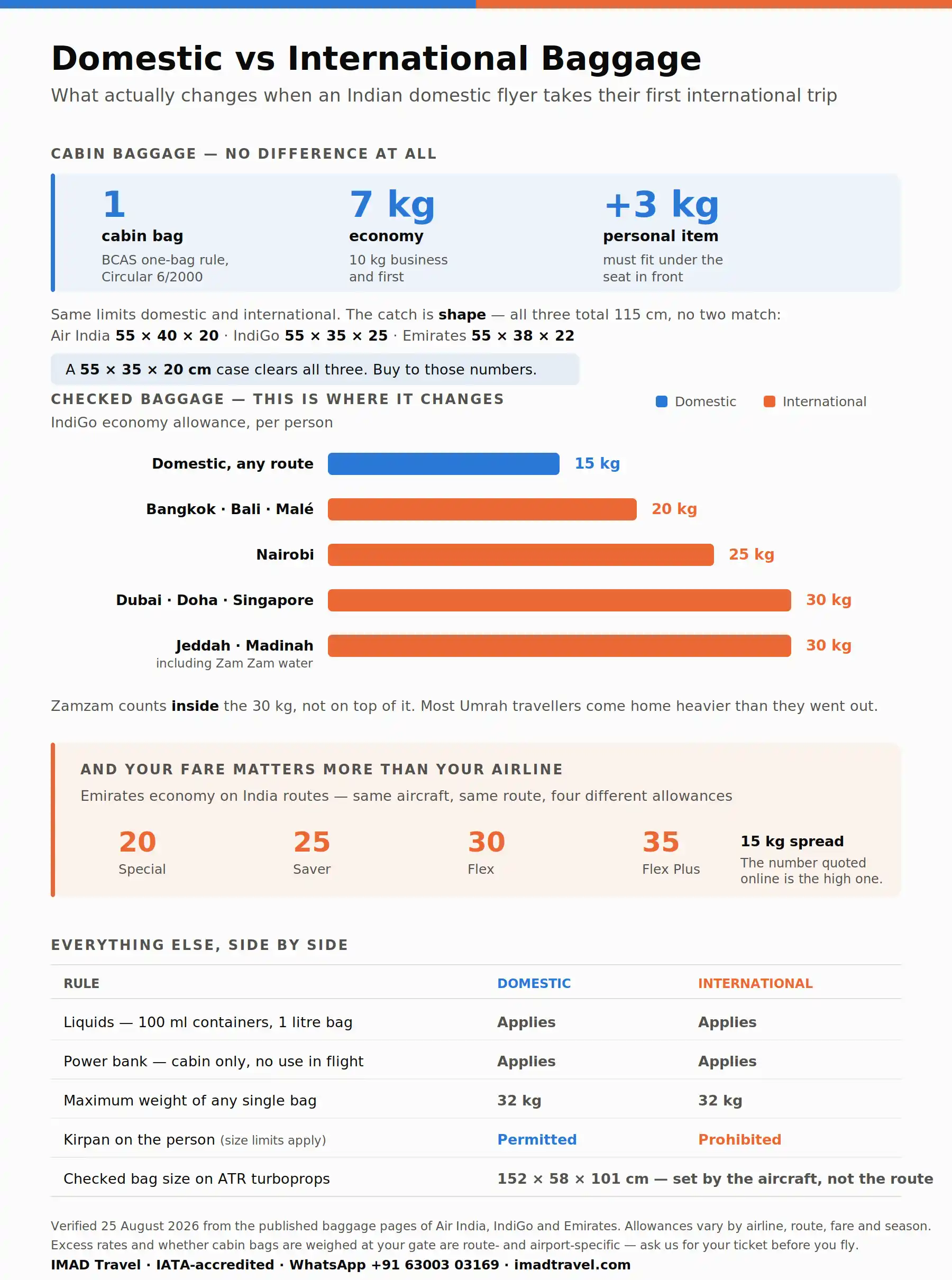
So this page covers both, side by side. Your cabin allowance does not change at all between a domestic and an international flight. Your checked allowance roughly doubles. That one sentence saves most of the arguments that happen at check-in counters.
Most baggage problems happen at the gate, not the check-in counter, and almost all of them are avoidable. The rules are not complicated — they are just scattered across three different authorities and every airline words them differently.
This is the version we give our own customers. IMAD Travel is an IATA-accredited agency and our flight booking agents ticket these routes every day, so where the published rule and the airport reality differ, we have said so.
Two things changed recently and catch people out: power banks can no longer be used in flight at all, and cabin bags are being weighed far more often than they were two years ago.
What is the difference between domestic and international baggage rules in India?
Your cabin baggage allowance does not change at all. Your checked allowance usually does, and it roughly doubles. If you have flown within India before, that is the one sentence you need — the bag you carry on board stays the same, and the bag you check in gets bigger.
Here is what actually differs:
| Domestic (within India) | International | |
|---|---|---|
| Cabin bags | 1 bag + 1 personal item | Same |
| Cabin weight | 7 kg economy · 10 kg business | Same |
| Cabin dimensions | 55 × 40 × 20 cm (Air India) · 55 × 35 × 25 cm (IndiGo) | Same |
| Checked allowance | 15 kg on IndiGo economy | 20–35 kg, by destination and fare |
| Liquids — 100 ml rule | Applies | Applies |
| Power banks | Cabin only, no in-flight use | Same |
| Maximum single bag | 32 kg | 32 kg |
| Kirpan on the person | Permitted, within size limits | Prohibited |
| Excess charged in | Rupees | Often the local currency of the route |
Three things first-time international flyers get wrong, and we see all three:
- They assume the cabin allowance goes up too. It does not. 7 kg on a Hyderabad–Delhi hop is 7 kg on a Hyderabad–Dubai flight, and the international sector is where people try to carry more
- They assume the 100 ml liquid rule is an international thing. It applies domestically as well. The half-used shampoo gets taken either way
- They pack to the airline’s headline allowance rather than their own fare. On international routes the two are frequently different by 10 kg or more — see the checked baggage section below
The one genuinely India-only item is the kirpan. Air India permits it on the person, within stated size limits, on flights operating within India only. On an international sector it is prohibited. If you are flying Amritsar–Delhi and then Delhi–Toronto, that changes mid-journey, and it needs to go into checked baggage before the international leg.
What are the cabin baggage rules for domestic and international flights from India?
You may carry one cabin bag plus one small personal item, and in economy the cabin bag must weigh 7 kg or less. Business and first class get 10 kg. The personal item — handbag, laptop bag, camera — must weigh under 3 kg and fit under the seat in front of you.
On Air India the published limits are:
| Economy & Premium Economy | Business & First | |
|---|---|---|
| Cabin bag | 7 kg | 10 kg |
| Maximum size | 55 × 40 × 20 cm | 55 × 40 × 20 cm |
| Total dimensions | 115 cm | 115 cm |
| Personal item | 3 kg · 40 × 30 × 20 cm | 3 kg · 40 × 30 × 20 cm |
The 115 cm figure is the one people miss. It is the three sides added together, and a bag can be under each individual limit and still fail it if it is overpacked and bulging.
How many cabin bags can I take from an Indian airport?
One. This is a security rule, not an airline policy, and it applies to every passenger in every class on every route out of India.
Here is the part almost nobody knows: the one-bag rule is not new. It comes from the Bureau of Civil Aviation Security’s “One Hand Baggage Rule”, Circular 6/2000, dated 24 February 2000 — it is twenty-six years old. What changed in recent years is enforcement, not the regulation.
That matters practically. If you flew out of an Indian airport in 2019 with two cabin bags and nobody stopped you, the rule was being broken then, not invented since. Arguing at the gate that “it was fine last time” does not work, because the officer is enforcing a circular older than the airline’s current fleet.
What this means when you pack: duty-free bought after security is generally fine. A second bag brought from home is not. Consolidate before you leave for the airport, not in the queue.
What is the cabin bag size for an international flight?
Roughly 55 × 40 × 20 cm on Indian carriers, but there is no single international standard and the variation between airlines is large enough to matter. European and Gulf carriers often allow more volume and less weight; Indian carriers do the reverse.
Buy your cabin case to the smallest airline you fly regularly, not the most generous. A case bought for a Gulf carrier’s allowance will not clear an Indian domestic gate.
Cabin and checked allowance by airline
| Airline | Cabin weight | Cabin size (cm) | Checked, economy | Max single bag |
|---|---|---|---|---|
| Air India | 7 kg economy · 10 kg business/first | 55 × 40 × 20 · 115 total | varies by route and fare | 32 kg |
| IndiGo | 7 kg · plus 3 kg personal item | 55 × 35 × 25 · 115 total | 15 kg domestic · 20–30 kg international by destination | 23 kg per piece · 158 cm |
| Emirates | 7 kg economy · 10 kg premium economy · business and first get a carry-on and a briefcase, 7 kg each | 55 × 38 × 22 · briefcase 45 × 35 × 20 | 20 / 25 / 30 / 35 kg by economy fare tier | 32 kg |
The three airlines allow the same total and three different shapes
This is the detail that costs people money at the gate, and no luggage shop will tell you:
| Airline | Length | Width | Depth | Total |
|---|---|---|---|---|
| Air India | 55 | 40 | 20 | 115 |
| IndiGo | 55 | 35 | 25 | 115 |
| Emirates | 55 | 38 | 22 | 115 |
Every one totals 115 cm. Not one of them has the same width or the same depth. A 40 cm-wide case clears Air India and fails IndiGo. A 25 cm-deep case clears IndiGo and fails Air India.
So the case that clears all three is 55 × 35 × 20 cm — the smallest number in each column. That comes to 110 cm, comfortably inside every limit above. If you buy one cabin case to fly all your routes, that is the size to buy, and almost nobody states it because it takes three separate airline pages to work out.
One India-only rule worth knowing: Emirates states that passengers boarding from India, in economy and premium economy, may carry one piece up to 115 cm total — the same figure Indian carriers use. So on a Hyderabad or Mumbai departure you are measured on the combined total rather than the three individual sides.
And in business or first, Emirates is more generous than it looks: you get a carry-on bag and a briefcase, 7 kg each. Air India gives one bag at 10 kg. On a long Europe itinerary in business, that is a real difference.
Whether your cabin bag actually gets weighed depends on the airline, the airport and the day. Some carriers weigh at the gate as a matter of routine, some almost never, and it changes by terminal. There is no published list, and anyone who gives you one is guessing. If you are close to 7 kg on a specific flight, ask us and we will tell you what that carrier is doing on that route right now — our desk tickets it every week.
Two allowances worth knowing if you are flying to Jeddah or Madinah
IndiGo’s published allowance to Jeddah and Madinah is 30 kg per person — and its own baggage page states that this is “including Zam Zam water”.
That single line answers a question we are asked on almost every Umrah booking. Zamzam is not a separate concession on that allowance; it counts inside your 30 kg like anything else. So a pilgrim carrying a 5-litre Zamzam can home has 30 kg to fit it into, not 30 kg plus the can.
Plan the return that way rather than the outbound. Most Umrah groups leave India well under the limit and come back over it, which is the single most common excess-baggage bill our desk sees.
See our Umrah packages from Hyderabad for what each group departure includes.
Flying to Jeddah or Madinah and worried about the return? Tell us before you fly, not at the airport. Adding allowance to a live ticket takes minutes and costs a fraction of the counter rate. WhatsApp +91 63003 03169.
Can I carry a power bank on a flight?
Yes, in your cabin bag only — but as of 2026 you cannot use it during the flight. This is the rule that catches the most people right now, because the device is still allowed; it is the charging that stopped.
Following a DGCA advisory reported in January 2026 after a series of onboard lithium-battery incidents, Air India’s published rules now state plainly: “Use or charging of power banks onboard is not permitted.”
The full picture:
| Rule | |
|---|---|
| Cabin baggage | Allowed — maximum 2 power banks per passenger |
| Capacity limit | 100 Wh each (roughly 27,000 mAh) |
| Checked baggage | Prohibited entirely. No exceptions |
| Using it in flight | Not permitted |
| Overhead bin | No — keep it with you, in the seat pocket or under the seat |
| Aircraft seat socket | Do not connect a power bank to it |
| Terminals | Must be individually protected against short circuits |
Why the overhead bin is banned specifically: a lithium fire is only manageable if the crew can reach it fast. A bag in an overhead bin four rows away is not reachable fast. That is the entire reasoning, and it is why the rule is about location, not just possession.
Two practical consequences. Charge your phone before boarding, because you now cannot top it up from a power bank in the air. And if you are connecting through a Gulf hub on a long Umrah or Europe itinerary, that is a genuinely long stretch — plan for it rather than discovering it at 30,000 feet.
Spare laptop and camera batteries follow the same logic: cabin only, terminals taped or in individual cases, never in checked baggage.
What is the liquid limit for carry-on baggage?
Every liquid in your cabin bag must be in a container of 100 ml or less, and all of them together must fit inside one transparent, re-sealable bag of one litre capacity.
The rule is about container size, not how full it is. A 200 ml bottle with 50 ml left in it fails. This is the single most common thing confiscated at Indian security, and it is almost always a half-used shampoo.
“Liquids” is broader than people expect. It covers gels, pastes, creams, aerosols and anything of similar consistency — so toothpaste, sunscreen, face cream, deodorant, hair gel and liquid foundation all count.
Three exemptions, all of which travel outside the one-litre bag:
- Medicines, in reasonable quantity for the journey. Carry the prescription
- Baby milk and infant food, if you are travelling with the child
- Special dietary requirements
Declare all three at security rather than hoping they pass unnoticed. Declared, they are routine. Found, they cost you time.
In checked baggage the 100 ml rule does not apply at all. The limits there are about flammable and pressurised items, not container size. So the answer to most liquid problems is simply to put them in the bag you are checking in.
What sharp objects are not allowed in flight?
Blades go in checked baggage. The exceptions people find surprising are the ones that are allowed.
Not permitted in the cabin on Air India: knives, scissors, box cutters, meat cleavers, razors, axes, cigar cutters and swords. Bladed sporting goods — ice skates, for instance — go in the hold.
Permitted in the cabin, and worth knowing because they get surrendered unnecessarily:
- Safety razors, including disposable razors
- Tweezers
- Nail files
- Nail clippers
The distinction is whether the blade can be removed and used. A disposable razor cannot; a cartridge razor with loose blades is a different matter, so pack spare blades in the hold.
Can I carry a lighter, matches or a vape on a flight?
No to all three on Air India, and this is stricter than most travellers assume.
Air India’s restricted-items list names lighters, gun lighters and lighter fluid as prohibited — not “cabin only”, but prohibited. E-cigarettes, e-cigars, e-pipes, personal vaporizers, all forms of Electronic Nicotine Delivery System, heat-not-burn products and e-hookah are also prohibited.
This is worth stating clearly because a lot of travel advice online says one lighter on your person is fine. On Air India it is not, and lighter policy is one of the areas where carriers and countries differ most. Check the airline on your ticket, and if in doubt, buy one at the destination — they cost almost nothing and a confiscation costs you a security screening.
One more, because the penalty is severe rather than inconvenient: cannabis and marijuana products are strictly prohibited, and Air India’s own guidance notes violations carry penalties including imprisonment of up to 20 years. That applies to products legal where you bought them.
Can I carry medicines and syringes on a flight?
Yes. Medicines are exempt from the liquid limit, and syringes are allowed with documentation from a healthcare provider.
What makes this go smoothly:
- Keep medication in its original labelled packaging, not a pill organiser
- Carry the prescription or a doctor’s letter, especially for injectables and controlled drugs
- Pack it in your cabin bag, not the hold — checked bags get delayed, and a delayed bag with your insulin in it is an emergency rather than an inconvenience
- Keep it somewhere you can reach without unpacking, and tell the officer before screening starts
For pilgrims travelling on longer Umrah itineraries, and for older travellers on group departures, we go through this at the booking stage rather than leaving it to the airport.
What are the checked baggage rules for international flights?
The standard economy allowance on most international routes is 23 kg per bag, and no single bag may exceed 32 kg regardless of how much allowance you have bought.
The 32 kg ceiling is not an airline preference. It is a manual handling limit — above it, ground staff are not permitted to lift the bag. If you have 40 kg of allowance, it must travel as two bags, not one heavy one.
Your fare decides your allowance, not your airline. This is the part that costs people money, and Emirates publishes the clearest proof of it. On India routes Emirates uses a weight allowance, and in economy alone it runs:
Emirates economy fare | Checked allowance |
|---|---|
| Special | 20 kg |
| Saver | 25 kg |
| Flex | 30 kg |
| Flex Plus | 35 kg |
| Premium Economy | 35 kg |
| Business | 40 kg |
| First | 50 kg |
Same airline, same aircraft, same route — a 15 kg spread across four economy fares. Someone who books the cheapest fare on a comparison site and assumes “Emirates gives 30 kg” arrives at the airport 10 kg over. The headline number that shows up in search results is almost always the Flex one.
Route matters too — the same carrier often gives more to North America than to the Gulf — and IndiGo’s international allowance ranges from 20 kg to Bangkok, Bali and Malé up to 30 kg to Dubai, Doha and Singapore.
When we ticket a fare we tell you the allowance on that fare, before you pay. That matters more than it sounds, and the next section explains why.
Not sure what your fare actually includes? Send us the route and dates and we will tell you the exact allowance before you book. WhatsApp +91 63003 03169.
Why does the cheapest flight ticket often not include baggage?
Because the ticket price is what gets compared, and the bag is sold to you afterwards. A fare with no checked baggage will always sort above one that includes it — not because it is better value, but because the thing being ranked is the smaller of two numbers.
This is our own observation from ticketing these routes daily, and it is worth saying plainly because nobody selling you a ticket online has any reason to:
- Some sites do not show the allowance at all until you are several steps into checkout, by which point you have already decided
- Some show it in small print beside a fare name — Special, Saver, Light, Basic — that means nothing until you know it is the no-bag one
- The add-on comes after the choice, not before it. You pick on price, then you are offered the bag. That ordering is deliberate and it works
Add the bag back and the ranking frequently reverses. A fare that is ₹2,000 cheaper with no baggage, against one that includes 25 kg, is not ₹2,000 cheaper — it is however much that airline charges for 25 kg more expensive, and that is often the larger number.
The only comparison worth making is fare plus the baggage you will actually check, on both options, before you book. No booking site does that arithmetic for you, because doing it would reorder its own results.
This is one of the plainest reasons to have a person quote your ticket instead of a screen. When Mr. Shafi Ansari’s desk quotes you a fare, the allowance on it is stated up front, and if the cheaper-looking fare works out dearer once your bag is on it, we tell you.
Ask us to price it both ways. Send your route, dates and roughly how much baggage you expect to check, and we will come back with the real total on each option — not the headline. WhatsApp +91 63003 03169 or see our flight booking service.
What is the luggage weight allowed on a domestic flight in India?
Fifteen kilograms of checked baggage in economy on IndiGo, plus the same 7 kg cabin bag you get on an international flight. That 15 kg is the figure most Indian domestic flyers are working from, and it is the number that changes the moment they book their first international ticket.
The domestic picture, in full:
| Domestic economy | |
|---|---|
| Checked baggage | 15 kg on IndiGo · varies by airline and fare |
| Cabin baggage | 7 kg, one bag |
| Personal item | 3 kg, under the seat |
| Maximum single bag | 32 kg |
| Extra allowance on multi-seat bookings | IndiGo adds 10 kg on double or multi-seat bookings |
Three things that catch domestic flyers out:
- Not every fare includes a checked bag. Low-fare bundles on Indian carriers increasingly do not, and the cheapest fare on a comparison screen is frequently the one with no bag at all. Add the bag back and the cheapest option often is not
- 15 kg is per person, not per booking. A family of four has 60 kg across four tags, and no single bag may exceed 32 kg
- The 100 ml liquid rule applies domestically too. People assume it is an international rule. It is not, and the half-used shampoo gets taken at Hyderabad just as readily as at Dubai
If you are flying domestically now and internationally later in the year, the useful takeaway is that only your checked allowance changes — roughly doubling — while everything you carry into the cabin stays exactly the same.
Booking your first international ticket? We do domestic and international ticketing both, and we will tell you the baggage allowance on your fare before you pay for it. WhatsApp +91 63003 03169 or call +91-40-35416788.
Does the baggage rule change with the aircraft or the plane size?
Your weight allowance does not change with the aircraft. The maximum size of a checked bag sometimes does, and it is smaller on turboprops.
This is worth knowing because a lot of Indian domestic flying, and the feeder legs of international itineraries, happen on ATR turboprops rather than jets. IndiGo publishes it plainly: on ATRs a checked bag must not exceed 152 × 58 × 101 cm, against the 158 cm total that applies on its jet fleet. The hold is physically smaller and the loading door is narrower.
Two practical consequences on a small aircraft:
- A large hard case can be refused on an ATR even though it flew fine on the jet leg. If your itinerary mixes the two, the turboprop leg sets your maximum, not the jet
- Overhead bins are much smaller. Your cabin bag may be taken at the aircraft steps and placed in the hold, returned to you on arrival. This is normal and not a penalty — but it means anything you need in flight, and anything you cannot risk losing, should be in your personal item
What does not change with the aircraft: the 7 kg cabin limit, the one-bag rule, the 100 ml liquid rule, the power bank rules and your checked weight allowance. Those follow the airline, the route and your fare — never the aeroplane.
What is not allowed in checked baggage?
Anything with a lithium battery that is not installed in a device, plus anything flammable, pressurised or explosive.
The list that catches Indian travellers most often:
- Power banks and spare lithium batteries — cabin only, always
- E-cigarettes and vapes — cabin only where permitted at all, never in the hold
- Lighters and lighter fluid
- Gas canisters — including camping cylinders and large aerosols
- Fireworks and crackers — a real problem in the Diwali travel window
- Matches
The reasoning is the same as the power bank rule: a fire in the hold cannot be reached. Anything that can start one travels where a human can see it.
Also worth keeping out of the hold even though it is permitted: passports and documents, jewellery, cash, laptops, cameras, medicines and one change of clothes. Not because of rules — because of the next section.
How much do excess baggage charges cost?
Buying extra allowance in advance is always cheaper than paying at the airport, usually by a wide margin. Airport excess is charged per kilogram at the highest rate the airline sells, and it is the most expensive baggage you can possibly buy.
There is no single excess rate, and be sceptical of any article that gives you one. It is set per kilogram, and it changes by airline, by route, by season and by whether you buy it online, at check-in or at the gate. A rate that is true for Dubai in September is not true for Jeddah in Ramadan.
What is reliably true is the shape of it:
- Buying in advance is always cheaper than at the airport, usually by a wide margin
- Airport excess is the most expensive baggage you can buy — it is the walk-up rate
- It is often more than the fare difference to a higher fare bundle that would have included the allowance in the first place. That comparison is worth making before you book, not after
So ask rather than guess. Tell us your route, your travel dates and roughly how far over you expect to be, and our ticketing desk will give you the actual number on your carrier — and whether it is cheaper to add allowance or simply move up a fare. That takes one WhatsApp message and it is the single easiest way to not lose money at an airport counter.
If you know you will be over — and on Umrah returns with Zamzam and gifts, most people are — tell us before you fly rather than at the airport. Adding allowance to a live ticket takes a few minutes.
How do I pack light enough to stay inside the cabin limit?
Weigh your bag at home before you leave, because 7 kg is less than it sounds. A cabin case that is empty at 2.5 kg leaves you 4.5 kg of contents, and that goes fast.
What actually works, in the order it saves the most weight:
- Wear the heavy things. Shoes, jacket and jeans on your body do not count against the cabin limit. This alone is often 2 kg
- Shoes are the enemy. Two pairs maximum, one of them on your feet
- Decant toiletries into 100 ml bottles, or buy them at the destination. Full-size toiletries are both a weight problem and a security problem
- Roll, do not fold — it fits more into the same 115 cm and reduces creasing
- Electronics and chargers into the personal item, which has its own 3 kg allowance
- Leave room for the return. Almost every trip comes home heavier than it went out
For a long Europe itinerary across several countries, packing for five days and doing laundry once beats packing for fifteen. Every group we run has at least one traveller who learns this the hard way.
Where do I put my cabin bag on the plane?
Under the seat in front of you, or in the overhead bin — and stow it as soon as you board rather than after you have settled in.
Two exceptions worth knowing before you choose your seat: bulkhead and exit-row seats must use the overhead bin, because there is no seat in front to put anything under. If you like keeping your bag at your feet, those seats are not for you despite the legroom.
And as above: the power bank does not go in the bin. Keep it in the seat pocket or in the bag under your seat.
What should I do if my checked bag goes missing?
Report it at the airline’s baggage desk before you leave the airport. That report — the Property Irregularity Report — is what starts the trace, and every hour you delay makes the claim harder.
The sequence that works:
- Go to the airline’s baggage desk in the arrivals hall, before customs exit
- Get the PIR reference number in writing. Photograph it
- Give a delivery address, not just a phone number
- Keep your boarding pass and bag tag — most claims fail because the tag was thrown away
- Keep receipts for essentials you buy. Most airlines reimburse reasonable costs on a delayed bag
Most delayed bags arrive within 24 to 48 hours. It becomes a compensation matter rather than a tracing one at 21 days.
If we ticketed your flight, tell us as well. We can chase the airline through trade channels while you are chasing it as a passenger, and those are two different queues.
Book with an agent who checks your allowance before you fly
Baggage is the most common reason a smooth trip turns expensive at the airport, and it is entirely preventable. When IMAD Travel issues your ticket, the allowance on your fare — not the airline’s headline number — is confirmed with you before you pay.
Mr. Shafi Ansari, Head of Ticketing, and our team of IATA-accredited flight booking agents handle this every day, on Umrah routes to Jeddah, Europe itineraries across several carriers, and family trips where seats and bags both have to work out.
WhatsApp +91 63003 03169 or call +91-40-35416788, and see our flight booking service for what else we handle.
Baggage rules for domestic and international flights — frequently asked questions
What is the cabin baggage size for international flights?
Air India allows 55 × 40 × 20 cm, IndiGo 55 × 35 × 25 cm and Emirates 55 × 38 × 22 cm — all totalling 115 cm, with 7 kg in economy. The totals match but no two shapes do, so a case that clears one can fail another.
What cabin bag size works on every airline?
A case of 55 × 35 × 20 cm clears Air India, IndiGo and Emirates, because it takes the smallest figure in each dimension. It totals 110 cm, inside every 115 cm limit. If you are buying one cabin case for all your flying, buy to those numbers.
Does Zamzam water count in my baggage allowance to Jeddah or Madinah?
Yes. IndiGo’s published allowance for Jeddah and Madinah is 30 kg per person including Zam Zam water, so it counts inside your allowance rather than on top of it. Plan the return leg around it, because most Umrah travellers come home heavier than they went out.
Can I carry two cabin bags from an Indian airport?
No. One cabin bag plus one small personal item, under the Bureau of Civil Aviation Security’s One Hand Baggage Rule, Circular 6/2000 of 24 February 2000. It applies to every class and every route out of India, and it is now enforced consistently.
Can I use my power bank during a flight?
No. Using or charging a power bank onboard is not permitted, and it must not be connected to an aircraft seat socket or stored in an overhead bin. You may carry up to two power banks of 100 Wh each in your cabin bag, kept within reach.
Can I put a power bank in checked baggage?
No, never. Power banks and spare lithium batteries are prohibited in checked baggage without exception, because a fire in the hold cannot be reached by the crew.
What is the liquid limit for carry-on baggage?
Containers of 100 ml or less, all fitting inside one transparent re-sealable bag of one litre. The limit is on the container size, not how full it is. Medicines, baby milk and special dietary items are exempt and should be declared at security.
Can I put liquids in checked baggage?
Yes, and the 100 ml rule does not apply there. Checked-baggage limits are about flammable and pressurised items rather than container size, so most liquid problems are solved by checking them in.
Can I carry a lighter on a flight from India?
On Air India, no — lighters, gun lighters and lighter fluid are prohibited from both cabin and checked baggage. Lighter policy varies more between carriers and countries than almost any other item, so check the airline on your ticket rather than relying on general advice.
Can I carry an e-cigarette or vape?
Air India prohibits e-cigarettes, e-cigars, e-pipes, personal vaporizers, all Electronic Nicotine Delivery Systems, heat-not-burn products and e-hookah. Never pack them in checked baggage under any airline’s rules.
Are nail clippers and razors allowed in hand luggage?
Safety razors including disposable razors, tweezers, nail files and nail clippers are permitted in the cabin on Air India. Knives, scissors, box cutters and cartridge razor blades are not, and go in checked baggage.
What is the checked baggage weight limit for international flights?
Typically 23 kg per bag in economy, with 32 kg the absolute maximum any single bag may weigh — that ceiling is a manual handling limit for ground staff, not an airline preference. Split extra allowance across two bags rather than one heavy one.
Does my fare include a checked bag?
Your fare decides the allowance, not the airline. Emirates economy on India routes runs 20 kg on Special, 25 kg on Saver, 30 kg on Flex and 35 kg on Flex Plus — a 15 kg spread on the same aircraft. The number quoted in search results is usually the higher one. We confirm the allowance on your specific fare before ticketing.
How much is excess baggage per kilo?
There is no single rate. It is charged per kilogram and varies by airline, route, season and whether you buy it online, at check-in or at the gate — so any article quoting one figure is guessing. Buying in advance is always cheaper than the airport counter, and it is often cheaper to move up a fare bundle than to pay excess. Send us your route and we will give you the actual number.
Is the baggage allowance different on a domestic flight in India?
The cabin allowance is identical — one bag, 7 kg in economy, plus a 3 kg personal item. The checked allowance is where it changes: IndiGo gives 15 kg on domestic economy against 20 to 30 kg internationally depending on the destination. The 100 ml liquid rule and the power bank rules apply on both.
Does the aircraft type change my baggage allowance?
Your weight allowance does not change with the aircraft, but the maximum checked bag size can. IndiGo limits checked bags on ATR turboprops to 152 × 58 × 101 cm against 158 cm total on its jets, and turboprop overhead bins are small enough that cabin bags are often taken at the steps and placed in the hold.
Can I carry a kirpan on a flight?
Air India permits a kirpan on the person, within stated size limits, on flights operating within India only. It is prohibited on international sectors, so on a domestic-to-international itinerary it must move into checked baggage before the international leg.
What should I do if my checked bag goes missing?
Report it at the airline’s baggage desk before leaving the airport and get the Property Irregularity Report number in writing. Keep your boarding pass and bag tag, give a delivery address, and keep receipts for essentials. Most bags arrive within 24 to 48 hours.