
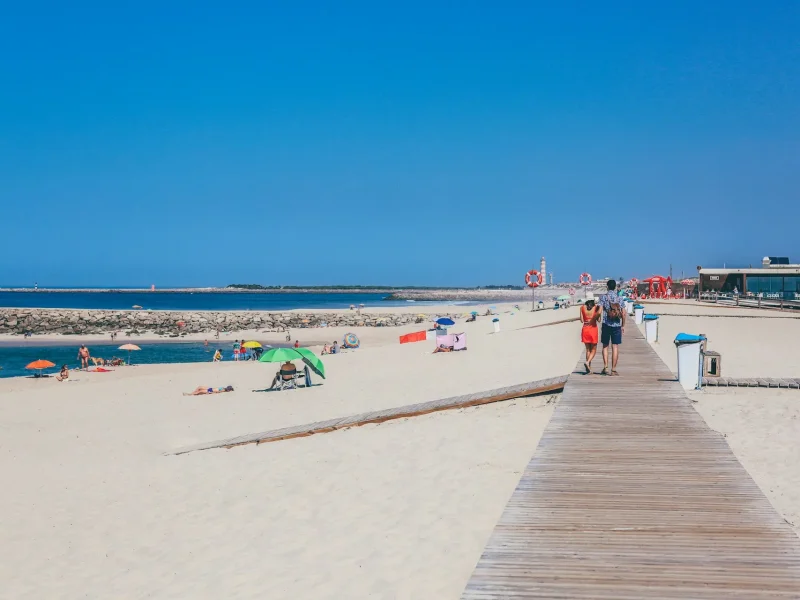
Europe in the summer of 2026 is running hotter than most travellers expected, and it is already changing where and when people choose to go. As this guide is written, western France has touched 44.3°C, large parts of Spain, Portugal and France are sitting in the low-to-mid 40s, and red heat alerts are stretched across the continent under a stubborn “heat dome.” (CNN, severe-weather.eu)
If you are an Indian family eyeing a July Europe holiday, or an international traveller weighing the Mediterranean against somewhere cooler, this matters for your comfort, your budget and your itinerary. The good news: a hotter Europe does not mean cancelling the trip. It means planning it more intelligently. This guide lays out the data on what is actually happening, why travellers are shifting, and the practical fixes — timing, destinations, packing and daily rhythm — that keep a Europe trip enjoyable instead of exhausting.
For travellers who would rather have all of this handled, IMAD Travel builds Europe tour packages from India around the seasons and routes that actually stay comfortable — more on that below.
Is Europe really getting hotter, or is this just one bad summer?
Europe really is getting hotter, and it is not a one-off. Europe is the fastest-warming continent on Earth, warming roughly twice as fast as the global average since the 1980s, according to the World Meteorological Organization and the EU’s Copernicus Climate Change Service. (WMO European State of the Climate, Copernicus)
That long-term trend is why heatwaves now arrive earlier, last longer and reach further north than the postcards suggest. The 2026 June heatwave is being driven by an “omega block” — a stalled high-pressure system that traps hot, dry Saharan air and presses it down over the continent for days at a time. (severe-weather.eu) For a traveller, the takeaway is simple: peak-summer heat in southern Europe is now a planning factor, not a footnote.
Why the heat is worth taking seriously
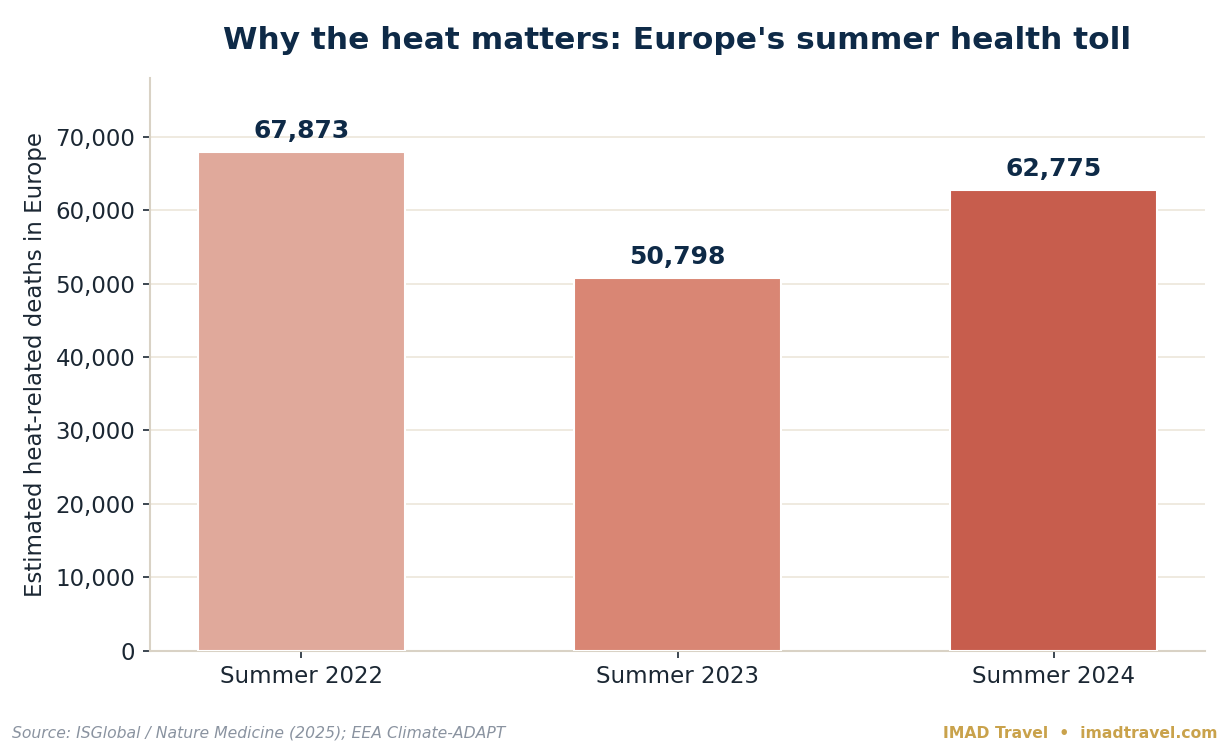
The honest reason to plan around the heat is health, not just comfort. Record temperatures in recent European summers have carried a real human cost. An estimated 62,775 heat-related deaths occurred across Europe in the summer of 2024 — following roughly 67,873 in 2022 and 50,798 in 2023 — according to research led by the Barcelona Institute for Global Health (ISGlobal), published in Nature Medicine. (ISGlobal, Nature Medicine)
The burden falls hardest on older travellers: in people over 75, the estimated heat-mortality rate was dramatically higher than in younger groups. (EEA Climate-ADAPT) That is directly relevant to the multi-generational groups many of us travel in — grandparents on a first European trip, young children, anyone with a heart or respiratory condition. None of this is a reason to fear Europe. It is a reason to schedule the trip when the continent is kinder, and to build a daily routine that respects the midday sun.
The "coolcation" shift: travellers are already voting with their bookings
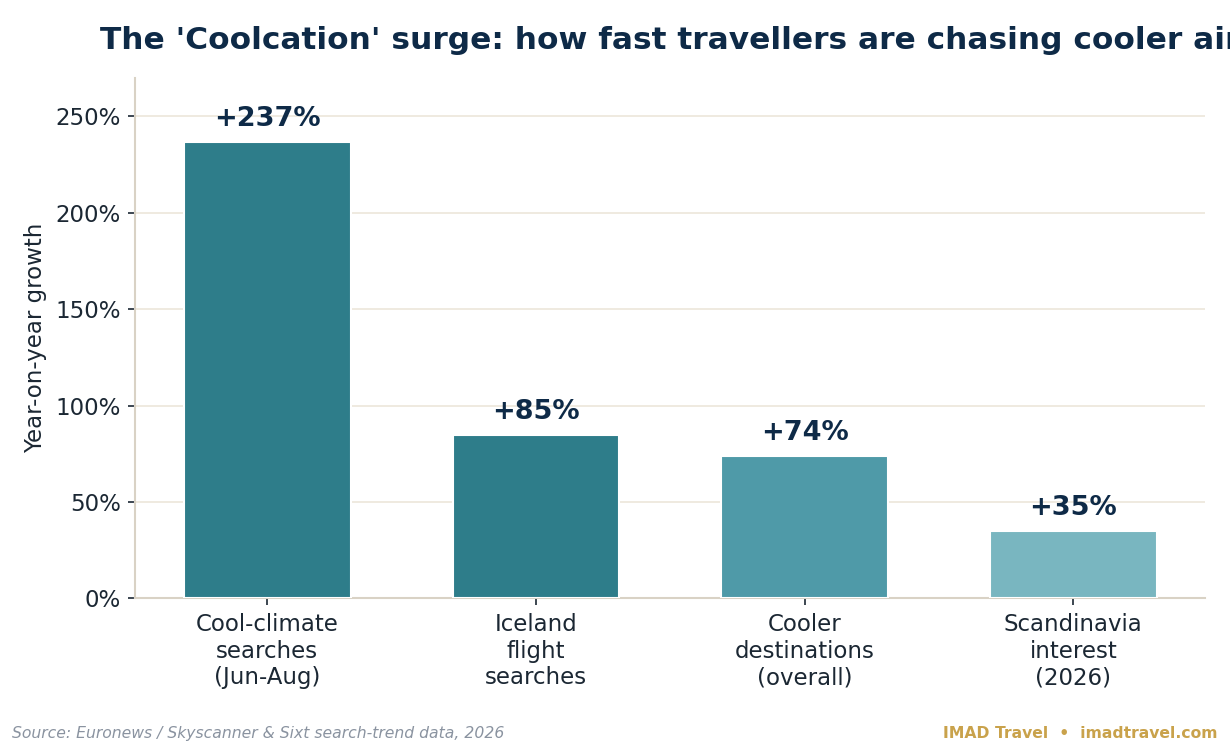
Travellers across the world are already adjusting, and the search data shows it clearly. A new travel pattern — the “coolcation,” choosing cooler places or cooler months — has moved from a buzzword to a measurable trend in 2026.
Searches for cool-climate destinations over the June–August window have jumped about 237% year on year, Iceland flight searches are up roughly 85%, interest in cooler destinations overall is up around 74%, and one major car-rental firm reported a 35% rise in Scandinavia interest for 2026. (Euronews, CNBC)
This is backed by attitude data, not just clicks. The European Travel Commission found that 81% of Europeans now consider climate when planning a trip, about 20% are planning to travel outside peak season, and roughly 40% intend to avoid destinations prone to extreme weather. (European Travel Commission via EU Tourism Platform) Finland, Norway, Poland and Iceland have all been recording double-digit growth in inbound visitors. (theweather.net)
It is worth a note of balance: not everyone in the industry believes the tourism map is being redrawn overnight. The UK travel association ABTA has cautioned that strong interest in cooler destinations “remains the exception rather than the norm” for now. (National Geographic) The sensible reading is that you do not have to abandon Italy or Spain — you just have to be smarter about when you go.
The single biggest fix: travel Europe in the shoulder season
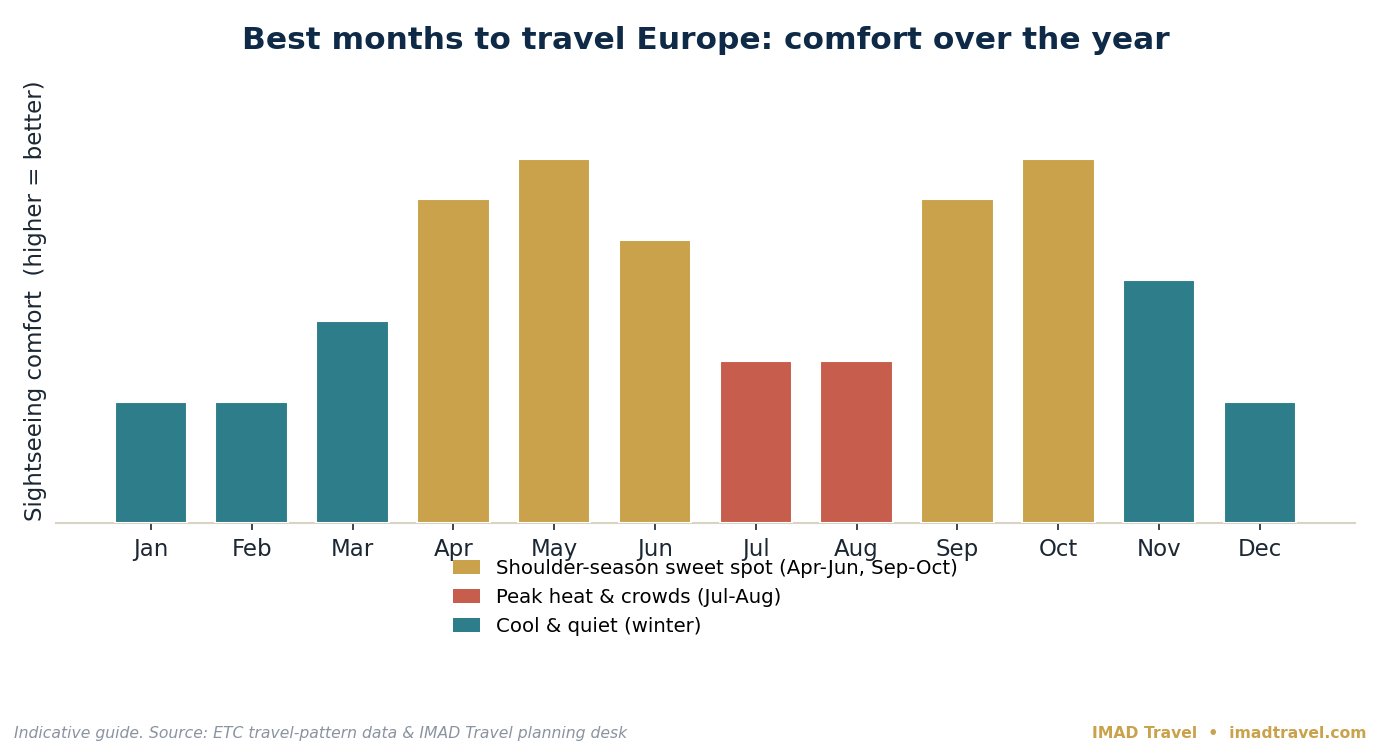
If you take one thing from this guide, make it this: shifting your trip out of July–August and into the shoulder season solves most of the heat problem at once. Late April to mid-June and September to October give you the weather people actually travel for — warm but walkable — without the peak-summer multiplier on flights, hotels and crowds.
For Indian travellers specifically, April–June and September–October are widely recommended as the best windows to visit Europe — pleasant weather, moderate crowds and better airfares and hotel rates than peak July–August. (Travelexie) This timing also dovetails neatly with Indian travel rhythms: a September–October trip sidesteps the brutal Mediterranean midsummer and lands you in Europe just as the light turns golden and the vineyards come into harvest.
The rest of the world is moving the same way. Skyscanner’s 2026 trends report found that nearly a third of travellers now plan to visit popular places only in the shoulder seasons; Florence saw autumn bookings up around 110%, and Croatia’s July–August 2025 numbers hit a “historic low” as visitors slid into the cooler months. (Travel And Tour World, CNN) Booking in the shoulder season is no longer a compromise — increasingly, it is the main event.
If you want help locking in those dates, our team can map a Europe tour package from India to the exact week that balances weather, price and your leave calendar. Because a Schengen visa adds lead time, the shoulder-season plan works best when you start early — our Schengen visa assistance team typically advises beginning the process well ahead of travel.
Where to go: cooler regions that stay comfortable in summer
If your dates are fixed to summer, the answer is to choose cooler geography rather than fighting the heat. You do not have to fly all the way to the Arctic Circle to feel the difference — though the Nordics are genuinely having a moment.
The Alps and Switzerland. Mountain air keeps places like the Swiss Alps, the Italian Dolomites and the Austrian Tyrol far more comfortable than the Mediterranean coast in July. Lake Geneva and Interlaken stay breezy while Rome bakes. This is also classic first-Europe-trip territory for Indian families. Our Switzerland and Alps tour packages are built around exactly this kind of high-altitude relief.
Northern and Nordic Europe. Norway’s fjords, Finland, Iceland and Sweden are the headline “coolcation” destinations of 2026 — cool temperatures, long daylight hours and dramatic landscapes, with Iceland topping a widely-cited “summer heat escape” index this year. (Travel And Tour World)
The Atlantic edge and higher ground. Coastal and elevated spots — Porto and Portugal’s north, Ireland, the Scottish Highlands, Slovenia’s lakes, the Dalmatian coast in spring — deliver the European experience without the inland-summer furnace. (Smarter Travel)
A practical point of view, from booking these trips for years: we do not recommend a packed seven-country, peak-July itinerary for first-time travellers or for groups with seniors. The combination of heat, long coach days and crowds is where a “dream trip” turns into an endurance test. A tighter route through cooler regions, or the same route in a cooler month, almost always produces a happier group.
If you do travel in the heat: how to stay comfortable and safe
If your trip lands in a heatwave, a few simple habits make the difference between a great day and a miserable one. The advice below is drawn from medical and travel-safety guidance issued during the 2026 heat events.
Pack for heat, not for photos. Choose loose, light-coloured clothing in natural breathable fabrics — linen and cotton let your skin breathe; avoid tight cuts, dark colours and synthetics that trap heat and sweat. (Trafalgar) Add a wide-brimmed hat, UV-protection sunglasses, a refillable water bottle and a high-SPF sunscreen you actually reapply.
Run your day around the sun. Do your sightseeing and walking tours early — ideally before 11 a.m., when it is cooler and quieter — then move indoors during the hottest hours. Most experts advise staying out of direct sun between roughly 11 a.m. and 3 p.m. (Time) Save air-conditioned museums, churches, galleries and long lunches for that midday window; this is a more comfortable rhythm anyway.
Hydrate properly. Drink water steadily rather than waiting until you feel thirsty, carry a bottle whenever you head out, and go easy on alcohol, which dehydrates you. In extreme heat, water alone may not be enough — replace electrolytes too. (MobiDoctor)
Re-think strenuous outdoor activity. Save hikes, long bike rides and open-air theme parks for the cooler regions or cooler hours. Seek shade often, and a wet cloth on the back of the neck cools you quickly. For older travellers or anyone with a health condition, treat a red-alert day as an indoor day — there is no sightseeing worth a hospital visit.
Quick reference: timing, regions and packing at a glance
- Best months from India: April–June and September–October — warm, walkable, better prices, smaller crowds.
- Months to approach with caution: July–August in southern Europe (Spain, Italy, Greece, southern France) — peak heat, peak crowds, peak prices.
- Coolest summer regions: Swiss/Austrian/Italian Alps, Norway, Finland, Iceland, Ireland, Scotland, Slovenia, northern Portugal.
- Pack: linen and cotton, light colours, hat, sunglasses, SPF, refillable bottle, electrolytes.
- Daily rhythm: outdoors before 11 a.m., indoors 11 a.m.–3 p.m., back out in the evening.
Plan a Europe trip that stays comfortable — with IMAD Travel
A hotter Europe rewards good planning, and that is exactly what we do. As an IATA-certified agency with 15 years of experience sending Indian travellers across Europe, IMAD Travel builds itineraries around the seasons, regions and daily pacing that keep your trip comfortable — whether that is a September Alps loop, a cooler Nordic escape, or a shoulder-season run through Italy timed to miss the worst of the heat. We also handle the part that quietly makes or breaks a summer trip: getting your Schengen visa sorted early enough to lock in the right travel dates.
Ready to plan a Europe trip that actually feels like a holiday? Talk to an IMAD travel expert or WhatsApp us on +91 63003 03169, and we will match the right month, route and hotels to your group.
Sources: WMO European State of the Climate; Copernicus Climate Change Service; ISGlobal / Nature Medicine (heat-mortality study); European Environment Agency (EEA) Climate-ADAPT; European Travel Commission; CNN; Euronews; CNBC; Time; National Geographic; Skyscanner trends; Travel And Tour World. All statistics are attributed inline. Charts are original, built by IMAD Travel from the cited data. Last updated 25 June 2026 and reviewed by IMAD Travel’s Europe planning desk.
General FAQ - how to travel Europe in a heatwave
Is it safe to travel to Europe during the 2026 heatwave?
Yes, with sensible planning. Most travellers are perfectly fine if they avoid the midday sun (roughly 11 a.m.–3 p.m.), stay well hydrated, dress for the heat and choose cooler regions or cooler months. Extra care is warranted for older travellers, young children and anyone with a heart or respiratory condition, especially on red-alert days.
What is the best time to visit Europe from India in 2026?
April–June and September–October offer the best balance of pleasant weather, manageable crowds and better airfares and hotel rates. July–August brings the most intense heat and the highest prices, particularly in southern Europe.
What is a "coolcation"?
A coolcation is a holiday chosen specifically for cooler temperatures — either a cooler destination (Norway, Iceland, Finland, the Alps) or a cooler month (spring or autumn instead of midsummer). Searches for cool-climate trips have surged sharply in 2026 as travellers respond to record heat.
Which European destinations stay cool in summer?
The Swiss, Austrian and Italian Alps, Norway’s fjords, Finland, Iceland, Ireland, the Scottish Highlands, Slovenia and northern Portugal all stay noticeably more comfortable than the Mediterranean coast and inland southern Europe during July and August.
What should I pack for a hot Europe trip?
Loose, light-coloured clothing in linen or cotton, a wide-brimmed hat, UV sunglasses, high-SPF sunscreen, a refillable water bottle and electrolyte sachets. Avoid tight, dark or synthetic clothing that traps heat.
Should I cancel my summer Europe plans?
No. You usually just need to adjust them — shift dates toward the shoulder season, lean toward cooler regions, and plan your days around the heat. A travel expert can rework an itinerary so you keep the destinations you want while dodging the worst of the heat.