
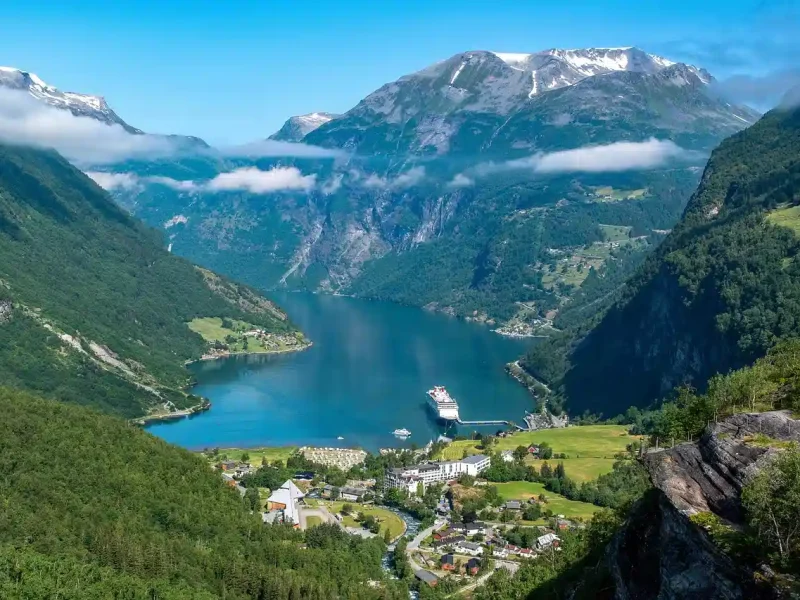
Norway is the most expensive country most Indian travellers will ever visit, and the good news is that its best sights are free. The fjords cost nothing to look at. The hikes cost nothing to walk. What costs money is getting between them, which is why the order you visit things in matters more here than almost anywhere else.
This guide covers the places to visit in Norway by region — Oslo and Bergen at either end of the country’s most famous train line, the fjords between them, and the Arctic north where the Northern Lights are — and it ends with the best month to go, because in Norway that single choice changes what you can see at all.
Norway is inside the Schengen area, so Indian passport holders need a Schengen visa before travelling; our Schengen visa services team handles the application and the appointment. Our Norway tour packages cover the fjord route and Bergen, and if the aurora is the reason you are going, the Northern Lights tour packages from India are built around the season for it. Vipasha runs our Europe desk and plans these routes.
What are the best places to visit in Norway?
Norway’s main sights sit in three groups: Oslo and Bergen at either end of the country’s south, the western fjords between and around them, and the Arctic north — Tromsø and Lofoten — where the Northern Lights and the midnight sun are.
Most first trips take the first two. The route from Oslo through the fjords to Bergen is the classic, it is well served by trains and boats, and it can be done without hiring a car. The north is a separate flight and a separate trip, and it is worth it only if you are going for the aurora or for Lofoten specifically.
One thing to be clear about before you plan anything else: Norway’s seasons are not a preference, they are a constraint. The fjords, the hiking and the midnight sun are June to August. The Northern Lights are September to March. There is no month that gives you both.
What is there to see in Oslo?
Oslo’s main sights are Vigeland Sculpture Park, the Opera House, the Munch Museum and the museums out at Bygdøy, and the city is small enough to cover in a day and a half.
Vigeland Sculpture Park, inside Frogner Park, holds over two hundred sculptures by one artist, all of the human figure, and it is free and open at all hours. It is the thing most people remember about Oslo.
The Opera House on the waterfront is designed to be walked on — the roof slopes down into the fjord and you can climb it without a ticket. The Munch Museum next to it holds the largest collection of his work anywhere.
Out at Bygdøy, a short ferry or bus from the centre, are the Fram Museum, which holds the polar exploration ship itself, and the Kon-Tiki Museum. Note that the Viking Ship Museum at Bygdøy has been closed for rebuilding — check its status before planning a day around it, because a lot of guides still list it as open.
Holmenkollen, the ski jump above the city, has a viewing platform and a ski museum, and the view over Oslo and the fjord from the top is the best in the city.
What can you see in Bergen?
Bergen’s sights are Bryggen, the old Hanseatic wharf on the harbour, the fish market beside it, and the Fløibanen funicular up Mount Fløyen — all within ten minutes’ walk of each other.
Bryggen is a UNESCO World Heritage Site: a row of wooden trading houses on the wharf, leaning at angles, with narrow passages behind them that are the real reason to go. The fish market is next door and is more tourist-facing than it used to be, but the seafood is genuine.
Fløibanen takes eight minutes to the top of Mount Fløyen and puts the whole city, harbour and islands below you. The Ulriken cable car goes higher and is quieter. If the weather is clear when you arrive, do one of them immediately — Bergen is one of the rainiest cities in Europe and clear afternoons should not be saved for later.
Bergen is the western end of the fjord country and the place most fjord trips start or finish.
What is the Norway in a Nutshell route?
Norway in a Nutshell is a fixed sequence of train, boat and bus between Oslo and Bergen that takes in the Flåm Railway and a fjord cruise, and it can be done in one long day or spread over two or three.
The sequence runs: the Bergen Railway from Oslo across the mountain plateau to Myrdal; the Flåm Railway down to sea level at Flåm; a cruise on the Nærøyfjord from Flåm to Gudvangen; a bus up the Stalheimskleiva switchbacks through the Nærøydalen valley to Voss; and the train on to Bergen.
The Flåm Railway is the centrepiece — twenty kilometres, twenty tunnels, one of the steepest standard-gauge lines in the world, with a stop at the Kjosfossen waterfall where the train pauses and everyone gets out. The Nærøyfjord is a UNESCO World Heritage Site and one of the narrowest fjords in the world; the cruise through it is the quiet hour of the whole route.
Worth adding if you have the time: the Stegastein viewpoint above Aurlandsfjord, a platform that projects out over a 650-metre drop, and the Aurlandsfjellet “Snow Road”, open in summer only.
Our honest advice on the one-day version: do not. It works on paper and it is what most people book, but you spend the day moving and you see the Nærøyfjord for an hour. Two days, with a night in Flåm or Voss, is the version worth having — and it costs very little more.
Planning Norway and not sure how many days it needs? Message our Europe desk on WhatsApp at +91 63003 03169 and ask for Vipasha. Tell us your dates and whether the Northern Lights matter — that answer decides the season, and the season decides the route.
Which fjords should you visit in Norway?
The four that matter are the Nærøyfjord and the Geirangerfjord, both UNESCO sites, and the two long ones they sit inside — the Sognefjord and the Hardangerfjord.
Nærøyfjord is the narrow, dramatic one, reached from Flåm, and it is on the Norway in a Nutshell route. Geirangerfjord is further north, with the Seven Sisters waterfall falling down the cliff opposite, and it needs its own detour or a coastal voyage to reach.
Sognefjord is the longest and deepest fjord in Norway and Nærøyfjord is one of its arms. Hardangerfjord, south of it, is the orchard one — apple and cherry blossom in May, which is a genuinely different reason to come.
You do not need to see all four. Seeing one properly, from the water rather than from a viewpoint, is worth more than driving past three.
What are the best hikes in Norway?
The three famous hikes are Preikestolen, Trolltunga and Kjeragbolten, all in the southwest near Stavanger, and they are very different in difficulty.
Preikestolen (Pulpit Rock) is the accessible one: a flat cliff plateau about 600 metres above the Lysefjord, reached by a round trip of roughly four hours on a well-built path. Most reasonably fit people can do it.
Trolltunga is not that. It is a full day — around ten to twelve hours round trip — and the season is short, roughly mid-June to mid-September. Do not attempt it as a casual add-on.
Kjeragbolten is the boulder wedged between two cliff faces that people stand on for the photograph. The hike is shorter than Trolltunga and steeper, with chains on some sections.
All three are summer-only in practice. Outside the season the paths are icy, the daylight is short and the shuttle buses do not run.
Where should you go for the Northern Lights in Norway?
Tromsø is Norway’s aurora base, roughly 350 km north of the Arctic Circle, with a season running from September to late March.
Tromsø has the infrastructure — flights, hotels, guides who chase clear sky rather than driving to one fixed spot, which matters more than any other factor. The Arctic Cathedral and the Fjellheisen cable car fill the daylight hours, which are short in winter.
The Lofoten Islands and Alta are the two alternatives, both further from a runway and both quieter. Lofoten gives you the aurora over mountains and sea rather than over a city, which is the better photograph if you are willing to work harder to get there.
The same rule as everywhere in the Arctic applies: give yourself several nights, not one. Cloud, not latitude, is what stops people seeing the lights.
What is there to see in the Lofoten Islands?
Lofoten is a chain of islands above the Arctic Circle where sharp mountains rise straight out of the sea, and the fishing villages of Reine, Hamnøy and Henningsvær are what people come for.
Reine and Hamnøy are the postcard villages — red rorbuer fishermen’s cabins on stilts over the water with peaks behind them. Henningsvær is built across several islets and has the football pitch surrounded by drying racks that turns up in every photo essay about the islands.
Lofoten works in two completely different seasons. Late May to mid-July gives the midnight sun — the sun does not set, and you can hike at two in the morning. September to March gives the aurora, along with heavy weather and very short days. Both are worth doing; they are not the same trip.
Which scenic train journeys are worth taking in Norway?
Three: the Bergen Railway across the mountain plateau, the Flåm Railway down to the fjord, and the Rauma Railway through the Romsdalen valley.
The Bergen Railway between Oslo and Bergen crosses the Hardangervidda plateau, the highest mainline railway in northern Europe, and it is seven hours of open mountain. The Flåm Railway is the twenty-kilometre descent covered above. The Rauma Railway, in the northwest between Dombås and Åndalsnes, runs past the Trollveggen rock face and is the one most itineraries miss.
Norway’s trains are the reason a fjord trip works without a car, and they are the cheapest premium experience in an expensive country — book the long ones ahead, because the cheap advance fares genuinely are much cheaper.
When is the best month to visit Norway?
June to August for the fjords, the hiking and the midnight sun; September to March for the Northern Lights. May and September are the quiet shoulder months and are better value than either.
June, July and August give you long days, open mountain roads, running ferries and every hiking trail accessible. They also give you the crowds and the highest prices.
September to March is aurora season in the north. In the south it is dark, wet and cold, and the fjord cruises run a reduced service.
May is the one to know about: apple and cherry blossom on the Hardangerfjord, waterfalls at full flow from the snowmelt, long days already, and prices well below July. September gives autumn colour, the first aurora nights, and far fewer people.
How many days do you need in Norway?
Five days covers Oslo, the Norway in a Nutshell route and Bergen. Adding Lofoten or Tromsø needs three more and a separate flight.
| Days | Route | Reaches |
|---|---|---|
| 5 | Oslo → Norway in a Nutshell over two days → Bergen | The classic fjord route |
| 7 | The above plus Hardangerfjord or Geirangerfjord, or Preikestolen from Stavanger | South and west Norway |
| 8–10 | Add a flight north to Tromsø or Lofoten | Fjords plus the Arctic |
| 10+ | Coastal voyage north, or Lofoten and Tromsø together | Most of the country |
Two practical notes. There are no direct flights from India, so every route connects through Europe — and Oslo in, Bergen out saves you a full day of backtracking. And Norway is expensive in a way that surprises people: eat where you are staying, buy alcohol at the duty free on the way in rather than in the country, and use the trains and public ferries rather than private transfers.
Frequently asked questions
What are the best places to visit in Norway?
Oslo and Bergen, the Nærøyfjord and Geirangerfjord, the Norway in a Nutshell route between Oslo and Bergen, the Lofoten Islands, and Tromsø for the Northern Lights.
Where should I go in Norway on a first trip?
Oslo, the Norway in a Nutshell route over two days, and Bergen. It covers the country’s most famous fjord scenery, it runs on trains and boats so you need no car, and it fits comfortably in five days.
What is the best month to visit Norway?
June to August for fjords, hiking and the midnight sun. September to March for the Northern Lights. May and September are the best value and are quieter than either.
Do Indians need a visa for Norway?
Yes. Norway is in the Schengen area, so Indian passport holders need a Schengen visa. There are no direct flights from India, so all routes connect through Europe.
Is Norway in a Nutshell worth doing in one day?
It is possible, but we would not recommend it. The one-day version is mostly spent moving. Two days, with a night in Flåm or Voss, costs little more and is a completely different experience.
Which is better for the Northern Lights, Norway or Iceland?
Tromsø in Norway has a longer, more reliable aurora season and better guided chasing. Iceland is easier to combine with waterfalls, glaciers and the Golden Circle in the same trip.
How many days do you need in Norway?
Five for Oslo, the fjord route and Bergen. Eight to ten if you are adding Tromsø or Lofoten in the north.
Is Norway expensive for Indian travellers?
Yes, noticeably. Food, alcohol and transfers are the three that surprise people. Trains and public ferries are good value, hiking and the fjord views are free, and travelling in May or September rather than July makes a real difference.
Planning a trip to Norway? Send us your travel dates, how many are travelling, and whether the Northern Lights are the point of the trip or a bonus — that one answer decides the season, the region and the route. Vipasha on our Europe desk will build it around that. WhatsApp +91 63003 03169, or see our Norway tour packages and Europe honeymoon packages from India.
Last verified: 29 August 2026. Museum closures, seasonal road openings and ferry schedules change. Confirm current status before you travel.